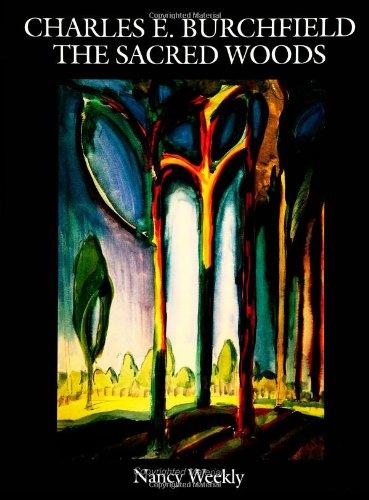
Charles E. Burchfield: The Sacred Woods
Out of stock
$15.00
Charles E. Burchfield: The Sacred Woods explores the underlying spirituality of American painter Charles E. Burchfield (1893-1967). Author Nancy Weekly, the Charles Cary Rumsey Curator of the Burchfield Art Center, traces the evolution of his art and philosophical fluctuations. She identifies his affinity for developments in 19th century art and literature, including pantheism, luminism, romanticism, and transcendentalism. The book celebrates the 100th anniversary of Burchfield’s birth. It is complemented by 40 color plates and 60 black and white illustrations. Burchfield was born in 1893 in Ashtabula, Ohio, and grew up in Salem, Ohio, which is depicted in youthful studies of nature, painted until he graduated from the Cleveland School of Art in 1916. His early work shares decorative compositional qualities with 19th century Japanese woodblock prints and reveals the influence of prevalent pantheistic philosophies and the literature of American authors, such as Henry David Thoreau, Walt Whitman, and Ralph Waldo Emerson. During 1917, which Burchfield called his “golden year,” he exaggerated nature’s sounds and movements in synesthetic, animated fantasies and invented a highly personal set of symbols he called “Conventions for Abstract Thoughts” to represent dreaded human emotions such as fear and morbidness. Surprisingly, during the 1920s when Burchfield still harbored the doubts of his youthful apostasy, he produced a small number of prints, drawings, and paintings based on Biblical subjects. After designing wallpapers for the M. H. Birge & Sons Company in Buffalo, New York from 1921 to 1929, the artist resigned to devote himself fully to his painting, encouraged by Frank K. M. Rehn of New York, who offered to be his art dealer. Burchfield became known as a painter of the American Scene, the champion of unpretentious small town life, as well as the urban documentarian who recorded the ennui of a man-made landscape, often being compared with his Rehn Gallery colleague, Edward Hopper. Dissatisfied with painting realistically, Burchfield returned in the 1940s to his fanciful style of 1917 and expanded old ideas, even the actual paintings themselves, into larger and more meaningful interpretations of nature. A lifetime of spiritual soul-searching and self-doubt, the recurrence of serious illnesses, and the steady persuasiveness of his wife, Bertha, led to Burchfield’s eventual adoption of the Lutheran faith in 1943-44. Autobiographical, romantic landscapes of this period contain his symbols for man’s place in the universal scheme. Majestic, transcendental evocations of the power of nature characterize the last decade of Burchfield’s works. The pinnacle of Burchfield’s aspirations is evidenced in his concept of a Mystic North, an imaginary, legendary place of deep mystery and elusive tranquility that he found in the secluded woods of the Western New York countryside.
This book is in Good readable condition. It has been read and may show some age & wear to the wraps/boards, or light creasing/wear to the pages. The binding may show very minimal wear, or be fully intact. Generally, most wear will solely be superficial.
*This came from a former professor’s collection, who used low-tack post-it notes to bookmark/annotate his books. Most of them have been removed, however it is possible that a stray few were overlooked. If this is the case, they are both unobtrusive and easily removable. Additionally, there may be annotations. In most, however not all cases, they are solely in the introduction/foreword. Any clarifying questions should be emailed to tornlight@gmail.com*
*Image in the listing is stock. There may be variation in the actual product.
| Genre | |
|---|---|
| Condition |
| Categories | Book, Print, Used Items |
|---|---|
| Stock Level | Out of stock |
| Share |
Related products
-

Sol Yurick – The Warriors
$17.00 | Book, PrintThe basis for the cult-classic film The Warriors chronicles one New York City gang’s nocturnal journey through the seedy, dangerous subways and city streets of the 1960s. Every gang in […]
GENRE: Fiction/Poetry/Essays/Criticism/Transgressive -
Matt Lifson – Sleep With Me And A Ghost
$25.00 | Book, PrintSoft cover, perfect bound 64 pages, 6.5 × 9-inch Edition of 500 Release date: October 1, 2016 Matt Lifson is a Los Angeles based artist. “Sleep With Me And A […]
GENRE: Art/Photography -
Nigel Ayers – Electronic Resistance
$70.00 | Book, PrintWhat our staff has to say: “A fantastically displayed retrospective of work by Nigel Ayers, including his ‘mail art, collages, assemblages, flyers, slides, video stills, ephemera, [...]
GENRE: Industrial / Power Electronics -
Joan Lindsay – Picnic at Hanging Rock
$16.00 | Book, PrintA 50th-anniversary edition of the haunting novel about the disappearance of three boarding school girls that inspired the acclaimed film It was a cloudless summer day in the year 1900. […]
GENRE: Weird Fiction/Sci-Fi/Unexplained Phenomena -
Luke Fischbeck – Beyond Majority Rule
$15.00 | Book, PrintSoft cover, perfect bound 64 pages, 6.5 × 9-inch Edition of 500 Release date: May 1, 2018 Beyond Majority Rule began by surveying how non-hierarchical groups make decisions, with a […]
GENRE: Art/Photography -
Matt Adis – Heads Of The Malnourished
$20.00 | Print, ZinePublished in 2020 by IQ32 Press 8.5″ x 11” zine – 24 pages Full color printed eggshell covers Includes single color 8.5”x11” risograph printed by Nick Flessa at the Los […]
GENRE: Punk / Hardcore
MORE FROM Art/Photography
-
Discreet Music Mag #2
$7.00 | Print, ZineSecond issue of Discreet Music Mag, featuring interviews with Greymouth and Jon Collin and a long piece on IDDB 001-044. Full colour, written in English. Discreet Music, 2021
GENRE: Art/Photography -
Fangoria Vol 2 #14 (January 2022)
$19.00 | Magazine, Print2022 is upon us! FANGORIA #14 rings in the new year with the one you’ve been waiting for… and one you’ll have to wait a little longer for. Here’s what […]
GENRE: Art/Photography, Horror Fiction -
Chris Marker – Staring Back
$15.00 | Book, Print, Used ItemsPhotographs by one of French cinema’s most influential and enigmatic artists. Any new film and any new book by French filmmaker Chris Marker is an event. Marker gave film lovers […]
GENRE: Art/Photography -
Parallel Public: Experimental Art In Late East Germany
$16.00 | Book, Print, Used ItemsHow East German artists made their country’s experimental art scene a form of (counter) public life. Experimental artists in the final years of the German Democratic Republic did not practice [...]
GENRE: Art/Photography, Non-Fiction -
Expanded Cinema: Fiftieth Anniversary Edition
$34.00 | Book, PrintFiftieth anniversary reissue of the founding media studies book that helped establish media art as a cultural category. First published in 1970, Gene Youngblood’s influential Expanded Cinema was [...]
GENRE: Art/Photography, Non-Fiction -
Intermedia, Fluxus and the Something Else Press: Selected Writings by …
$35.00 | Book, PrintWhat our staff has to say: “Fun book on one of the centers of the Fluxus movement. At the very least the one who helped create a written documentation of […]
GENRE: Art/Photography, Fiction/Poetry/Essays/Criticism/Transgressive