
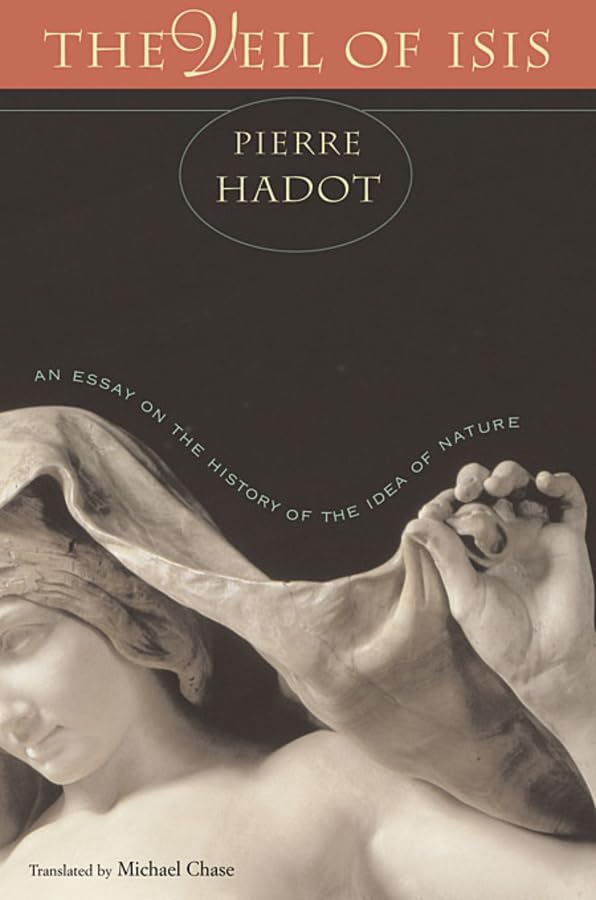
The Veil of Isis : An Essay on the History of the Idea of Nature
Out of stock
$15.00
Nearly twenty-five hundred years ago the Greek thinker Heraclitus supposedly uttered the cryptic words “Phusis kruptesthai philei.” How the aphorism, usually translated as “Nature loves to hide,” has haunted Western culture ever since is the subject of this engaging study by Pierre Hadot. Taking the allegorical figure of the veiled goddess Isis as a guide, and drawing on the work of both the ancients and later thinkers such as Goethe, Rilke, Wittgenstein, and Heidegger, Hadot traces successive interpretations of Heraclitus’ words. Over time, Hadot finds, “Nature loves to hide” has meant that all that lives tends to die; that Nature wraps herself in myths; and (for Heidegger) that Being unveils as it veils itself. Meanwhile the pronouncement has been used to explain everything from the opacity of the natural world to our modern angst. From these kaleidoscopic exegeses and usages emerge two contradictory approaches to nature: the Promethean, or experimental-questing, approach, which embraces technology as a means of tearing the veil from Nature and revealing her secrets; and the Orphic, or contemplative-poetic, approach, according to which such a denuding of Nature is a grave trespass. In place of these two attitudes Hadot proposes one suggested by the Romantic vision of Rousseau, Goethe, and Schelling, who saw in the veiled Isis an allegorical expression of the sublime. “Nature is art and art is nature,” Hadot writes, inviting us to embrace Isis and all she represents: art makes us intensely aware of how completely we ourselves are not merely surrounded by nature but also part of nature.
This book is in Good readable condition. It has been read and may show some age & wear to the wraps/boards, or light creasing/wear to the pages. The binding may show very minimal wear, or be fully intact. Generally, most wear will solely be superficial. *Image in the listing is stock. There may be variation in the actual product.
*This came from a former professor’s collection, who used low-tack post-it notes to bookmark/annotate his books. Most of them have been removed, however it is possible that a stray few were overlooked. If this is the case, they are both unobtrusive and easily removable. Additionally, there may be annotations. In most, however not all cases, they are solely in the introduction/foreword. Any clarifying questions should be emailed to tornlight@gmail.com*
| Genre | |
|---|---|
| Condition |
| Categories | Book, Book / Paper Goods, Print, Used Items |
|---|---|
| Stock Level | Out of stock |
| Share |
Related products
-

Emily Joyce – A Cigar Caught In The Lilies
$15.00 | Book, PrintSoft cover, perfect bound 64 pages, 6.5 × 9-inch Edition of 500 Release date: April 1, 2019 A Cigar Caught In The Lilies is a book of visual concrete poetry […]
GENRE: Art/Photography -
Joan Lindsay – Picnic at Hanging Rock
$16.00 | Book, PrintA 50th-anniversary edition of the haunting novel about the disappearance of three boarding school girls that inspired the acclaimed film It was a cloudless summer day in the year 1900. […]
GENRE: Weird Fiction/Sci-Fi/Unexplained Phenomena -
Boris Vian – Blues for a Black Cat & Other Stories
$15.00 | Book, Print“[This collection] displays Vian’s range from gallows humor to verbal fireworks, and happily serves to give visibility to this important writer.”- Publishers Weekly. [...]
GENRE: Fiction/Poetry/Essays/Criticism/Transgressive -
Maggot Brain – Issue #9
$12.00 | Magazine, PrintWELCOME TO MAGGOT BRAIN #9 – RAYMOND PETTIBON ON THE COVER! RAYMOND PETTIBON: IN CONVERSATION WITH ADAM WOODHEAD JOHN BRANNON: NEGATIVE APPROACH HONCHO UNLOADS JOHN WATERS: THE RETURN OF THE […]
GENRE: Fiction/Poetry/Essays/Criticism/Transgressive, Indie / Alternative -
Mata – No Drums No DJs No Saturdays
$15.00 | Book, PrintSoft cover, perfect bound 64 pages, 6.5 × 9-inch Edition of 500 Release date: October 1, 2016 MATA was a gallery located at 3709 West Pico Boulevard in Los Angeles […]
GENRE: Art/Photography -
Kate Hall – I Did But I Don’t Anymore
$15.00 | Book, PrintSoft cover, perfect bound 64 pages, 6.5 × 9-inch Edition of 500 Kate Hall is a Los Angeles based artist. I Did But I Don’t Anymore is a compilation of […]
GENRE: Art/Photography
MORE FROM Non-Fiction
-
Korm Plastics “The Second Annual”
$20.00 | Book, PrintFollowing the critically acclaimed first Annual, Korm Plastics is very proud to present The Second Annual, which has more pages and more authors and covers a wide selection of musical […]
GENRE: Non-Fiction -
Roots in Reverse: Senegalese Afro-Cuban Music and Tropical Cosmopolita…
$10.00 | Book, Print, Used ItemsRoots in Reverse explores how Latin music contributed to the formation of the négritude movement in the 1930s. Taking Senegal and Cuba as its primary research areas, this work uses […]
GENRE: International, Non-Fiction -
Graeme Thomson – I Shot a Man in Reno: A History of Death by Mur…
$10.00 | Book, Print, Used ItemsWhat do the gangsta rap devotee, the grizzled blues fanatic, the bearded folk fan, the goth and the indie kid have in common? Ask and they will all say the […]
GENRE: Non-Fiction -
Julie Hecht – Was This Man a Genius?: Talks with Andy Kaufman
$9.00 | Book, Print, Used ItemsJust as Andy Kaufman subverted traditional forms of comedy, Julie Hecht, with her deadpan wit and highly original style, subverts the traditional form of the profile with her acclaimed nonfiction [...]
GENRE: Non-Fiction -
Kamala Tiyavanich – In the Cool Shade of Compassion: The Enchant…
$8.00 | Book, Print, Used ItemsA fascinating collection of stories of the Thai forest monks that illuminates the Thai Forest tradition as a vibrant, compassionate, and highly appealing way of life. This work ingeniously [...]
GENRE: Non-Fiction -
Michel Leiris – Fibrils: The Rules of the Game, Volume 3
$10.00 | Book, Print, Used ItemsA beloved and versatile author and ethnographer, French intellectual Michel Leiris is often ranked in the company of Proust, Gide, Sartre, and Camus, yet his work remains largely unfamiliar to [...]
GENRE: Non-Fiction