Henry Flynt & The Insurrections – I Don’t Wanna
Out of stock
$33.00
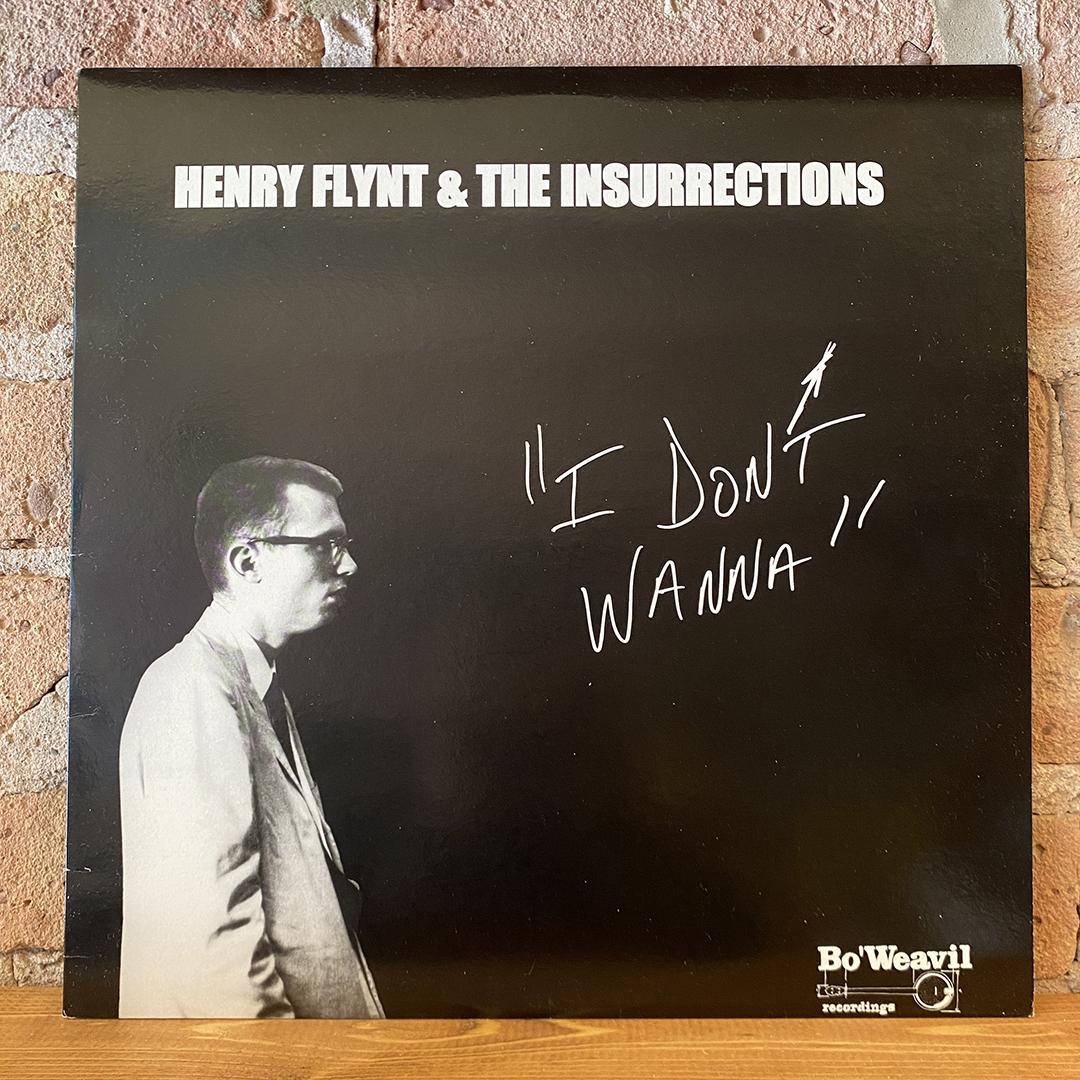
“Henry Flynt’s rock album is something of a bargaining chip in the ongoing intellectual commerce concerning his historical value as a musician and composer. I Don’t Wanna, the title scrawled in quotes, presents a black-and-white cutout of Flynt in white suit and black tie on its front cover. To someone aware of the great praise this artist has received for his remarkable recordings from the early ’80s, this CD cover might suggest the New York new wave rock scene of that same era. This material was recorded in 1966, however, meaning it is too late for the photograph to suggest the natty look of Gerry & the Pacemakers and way too early for the new wave. Those seeking to make sparks with this Flynt on any surface possible will make the new wave connection into an indicator of just how ahead of his time this artist was. On other critical faces sneers will start to form, anticipating informed comments along the lines of “I think the Flynt discography is wonderful…but not that rock album!” If Flynt had indeed made what rock nerds like to call a “jaw-dropping” album back in 1966 that was never released, it would of course be a feather in the cap that is bigger than the cap itself. This is just too much to expect, although on the whole the nine tracks here add up to a vision of rock music that most listeners will be perfectly happy to have in their heads for a while, maybe even give a repeat listen when it’s over. That would be just like a classic album from the ’60s, many of which would not stand up to a detailed critique without giving up at least a couple of tracks as duds. Flynt’s creations with the assistance of a loyal bassist, drummer, and keyboardist have even more things in common with the beloved rock records of the ’60s. In fact, the argument that this music was incredibly radical and different from what was going on at the time is difficult to accept. There is about a half an hour of music in total, just like a typical LP from the ’60s. The musical influences that Flynt brings to his collection of songs are the basic ones that were running through all rock from this period: country & western, old-time, folk, country blues, R&B, and so forth. In all three of his roles as a composer, guitarist, and vocalist, Flynt holds up well in comparison with anyone doing anything similar at the time, including the much better-known Captain Beefheart. His rock isn’t just weird, though — one of the best tracks, an instrumental entitled “Corona Del Mar,” is a straightforward take on the groove and progression used by Chuck Berry on the song “Memphis.” It is ironic that the latter recording, in which Berry experimented with using household objects for drums and lo-tech home studio recording, is actually the more avant-garde of the two. Had this album been released at the time of its recording and given decent circulation, perhaps some aspects of avant-garde rock would have wound up sounding different. This notion is based on the opinion that the majority of musicians just go and copy what someone else has already done. As history actually unfolded, Beefheart was pretty much the model for musicians who wanted to play rock that was liberated from traditional European classical songwriting form and the Tin Pan Alley concept of harmony that developed from that. A kind of “pattern music” came out of this, with many bands playing one riff or pattern that is repeated a certain number of times, then another, then another, just like Beefheart used to do. These patterns would often sound like something distilled out of the Delta blues. It is tremendously enjoyable to hear Flynt working in a similar manner but with his own sensibility, so much different than what developed out of Beefheart’s weird relationship with his own Magic Band. As a composer, Flynt has always made interesting choices, so it is too bad that dozens of rockers didn’t have the chance to imitate him. No matter how unique he might seem in a rock context, he made these recordings in an era when it was perfectly acceptable to be yourself musically. I Don’t Wanna is inevitably at its best when it is most like a typical ’60s album, like the way “Uncle Sam Do” kicks things off with a killer or rather anti-killer “protest song,” just like the way a vintage Country Joe & the Fish album would have started. Paul Breslin’s use of acoustic bass is part of an overall lightness to the music, at times suggesting rockabilly. The contributions of the supporting musicians should not be exaggerated but, even when weak, it makes the whole thing once again come off like a real ’60s album rather than some kind of super session involving avant-garde heavies. Something special happens with the interplay on many tracks, the feels including variations on slow blues, shuffles, and boogies. It is a kind of opening up of traditional forms, only a glimmer of the expansion of Flynt’s later work but a glimpse nonetheless of a great creative personality caught up with the excitement of the mainstream.” – allmusic.com
Label: Bo’Weavil Recordings – Weavil 02
Format: Vinyl, LP, Limited Edition, Numbered, Reissue
Country: UK
Released: 2004
VG+/VG+
| Genre | |
|---|---|
| Condition |
| Categories | LP, Used Items, Vinyl |
|---|---|
| Stock Level | Out of stock |
| Share |
Related products
-

Mia Loucks – Sister Honey Demos LP
$13.00 | LP, VinylBedroom music” as a genre is perhaps questionable, and yet when first hearing the cassette that these songs were originally released on, this was the thought that I was fixated […]
GENRE: Indie / Alternative -
Soft Shoulder – Contextual
$15.00 | LP, VinylTwo months after the recent ‘Aerosol Can Stand’ 7”, James Fella’s long-running group Soft Shoulder returns with 10 tracks recorded throughout 2018-2019 at various live performances, at their [...]
GENRE: Art Rock / Krautrock / Prog / Psych -
Filthy Grin – Saturn In The Mirror
$14.00 | LP, VinylGerald Biggs developed Filthy Grin as a living sound journal to document explorations in the sonification of sculpture and body movement. Currently located in Montreal, over the past decade he [...]
GENRE: Modern Composition / Musique Concrete / Electronic -
Nick Klein – Actor Network Theory
$10.00 | LP, Vinyl“Actor-Network Theory” is the final record Nick Klein made as a resident of New York City. Recorded in 2018, it weaves a disparate sonic narrative of dissociative opiated sleeping-bag [...]
GENRE: Techno / House / Electronic -
James Fella – Weak Left Input
$13.00 | LP, VinylWeak Left Input” LP (GGGR-070, September 2014): Two improvised and unedited pieces focusing on meandering / overlapping electronics, guitar and tape noise. Over an hour of material ranging [...]
GENRE: Modern Composition / Musique Concrete / Electronic -
Sequoyah Murray – Before You Begin
$9.00 | LP, Vinyl“At just 22 years old, Sequoyah Murray is crafting the kind of concise, singular musical statements that many artists strive for their whole careers. His mutant brand of modern soul […]
GENRE: Soul / Funk / Disco
MORE FROM Modern Composition / Musique Concrete / Electronic
-
Mark Trecka – Acknowledgment LP
$13.00 | LP, VinylLabel Description: Recorded using only voice, piano, and handmade cassette loops, Acknowledgment was conceived of and is presented as an intertextual document reflecting on 15 years of dialogue [...]
GENRE: Modern Composition / Musique Concrete / Electronic -
Personal Best 9
$16.00 | MagazineLasse Marghaug’s magazine Personal Best is back! Issue number 9 will be in hand and shipping mid to late June. Still my favorite magazine around. Issue 9 features interviews with […]
GENRE: Experimental / Noise, Modern Composition / Musique Concrete / Electronic -
Null Mutants – Syncing Feeling
$10.00 | Cassette, CSTHE FINAL RELEASE ON TORN LIGHT RECORDS Null Mutants is the Chicago-based duo of Todd Irwin and Nick Butcher. Accomplished graphic artists, the project finds the pair mixing deep reverence […]
GENRE: Experimental / Noise, Modern Composition / Musique Concrete / Electronic, Post-Punk / Goth / Darkwave / Minimal Synth / Neofolk, Reggae / Dub -
Similar Shapes – Sites CS
$9.00 | CSWhat our staff has to say: “Ambient soundscapes, environmental noise, all tinged with decay. Listening to this tape feels like library music you heard as a kid appearing in your […]
GENRE: Experimental / Noise, Modern Composition / Musique Concrete / Electronic -
Giuseppe Chiari – Gesti Sul Piano LP
$28.00 | LP, VinylEdition of 250 copies, historical recordings from 1975 and 1980. Giuseppe Chiari was one of the leading names associated first with Fluxus (being the only Italian member of the interdisciplinary [...]
GENRE: Experimental / Noise, Modern Composition / Musique Concrete / Electronic -
Aphex Twin – Selected Ambient Works Vol 2 – 4LP
$50.00 | 4xLPSelected Ambient Works Volume II (Expanded Edition) releases on Oct 4, 2024, celebrating the original album’s 30th anniversary. Written when Aphex Twin (Richard D. James) was in his early 20s, [...]
GENRE: Modern Composition / Musique Concrete / Electronic