Lean Forward and Read Liz Pelly’s ‘Mood Machine’
If you’ve been reading the blog for the past few months, my topics have tended towards discussions of music, data, streaming technology, and physical media. I’ve been preoccupied with these concepts as I wrestle with the ramifications of how the music industry has developed in the past fifteen to twenty years. The changes happened so gradually, and for myself during formative years of life, so that its as if one day I simply woke up and the music landscape was unrecognizable. These past few years in particular have made it feel like the twisted relationship between music and the Internet overlords is reaching some sort of breaking point. Sometimes I feel like it’s only me spotting these fractures, and I convince myself that perhaps all is well and that I am simply losing patience with the system, reading too much into things as I distance myself from digital over-saturation. But these past few weeks, I read Liz Pelly’s newest book, Mood Machine: The Rise of Spotify and the Costs of the Perfect Playlist, and I know now that I’m not the only one disillusioned. Pelly’s book aptly explains the details behind why so many people, especially those involved in independent and DIY music scenes, are maximally distressed by the ways in which Spotify has altered how we create and listen to music.
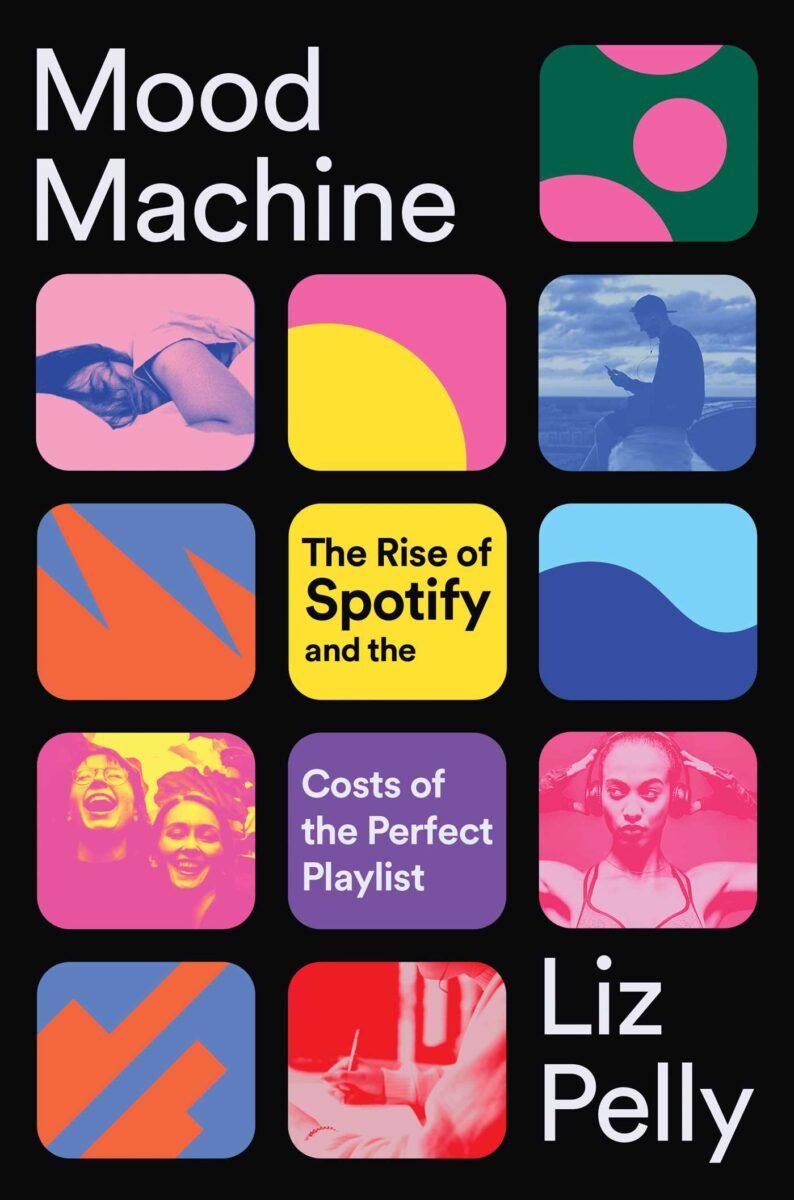
For a long time, I’ve sensed there is something nefarious about how Spotify commodifies data, swindles hardworking musicians out of their payments, and reduces everyday listening into a passive and detached form referred to as “lean-back” listening. Mood Machine exposes all of the details underneath these anxieties, putting facts, anecdotes, and perspectives in place to elucidate why we’ve reached this dysfunction in the music industry. Throughout the book, Pelly explores how Spotify has contributed to the “flattening” of the music industry into a homogenous sound through uniform consumption, has always existed to serve advertisers and investors first and foremost, has been built on catering to the lean-back listener, favors “inoffensive” and “repeatable” music all for the sake of playlists and vibes, and surveils and commodifies user data to power their functionality so that users hear more, but listen less. Pelly looks at PFC (“perfect fit content”) churned out as stock background music for lower royalty rates, the rise of functional music, Spotify’s data-obsessed mainstays such as the Discover Weekly playlist and Spotify for Artists, the proliferation of streaming microgenres that often erase DIY communities that pioneered those genres, how Spotify has decimated the indie music ecosystem, and the gradual introduction of artificial intelligence into Spotify’s framework.
One of the central topics of Pelly’s book is the lean-back listener, a type of user that Spotify decided early on to target in their advertising and functionality. The lean-back listener does not actively seek out a particular artist or album for listening, but rather logs on to passively soundtrack certain activities throughout their day, such as driving, studying, eating, or sleeping. Spotify recognized the potential of playlists to eradicate the element of choice for these more disengaged listeners, and sought to shape their user experience on Spotify by creating devoted background playlists for these daily tasks. In 2012, Spotify launched their “music for every moment” advertising campaign, which encouraged the use of playlists as background for focus, exercise, parties, and the now particularly overused, relaxing, or chill. “Music for every moment” effectively marked the shift from Spotify positioning themselves as a music discovery tool to a music curation service. One Spotify employee conveyed to Pelly, “I honestly think that the core of the company’s success was recognizing that they’re not selling music. They’re not providing music. They’re filling people’s time. And [Spotify founder Daniel Ek] said at a company meeting, I remember he was like, ‘Apple Music, Amazon, these aren’t our competitors. Our only competitor is silence.’” Like many digital services, especially the mind-numbing infinite scroll of social media, Spotify enables individuals to fill their days with shallow music, often the aforementioned anonymous PFC, devaluing not only music but also people’s precious time. The effect is even somewhat dehumanizing for both listeners and musicians, and as Pelly says, “The relentless promotion of anonymous producers seems to be part of a larger effort that aims to disconnect listeners from the makers of the music they’re consuming, laying the groundwork for users to accept the hyper-normalization of music made using generative AI software.”
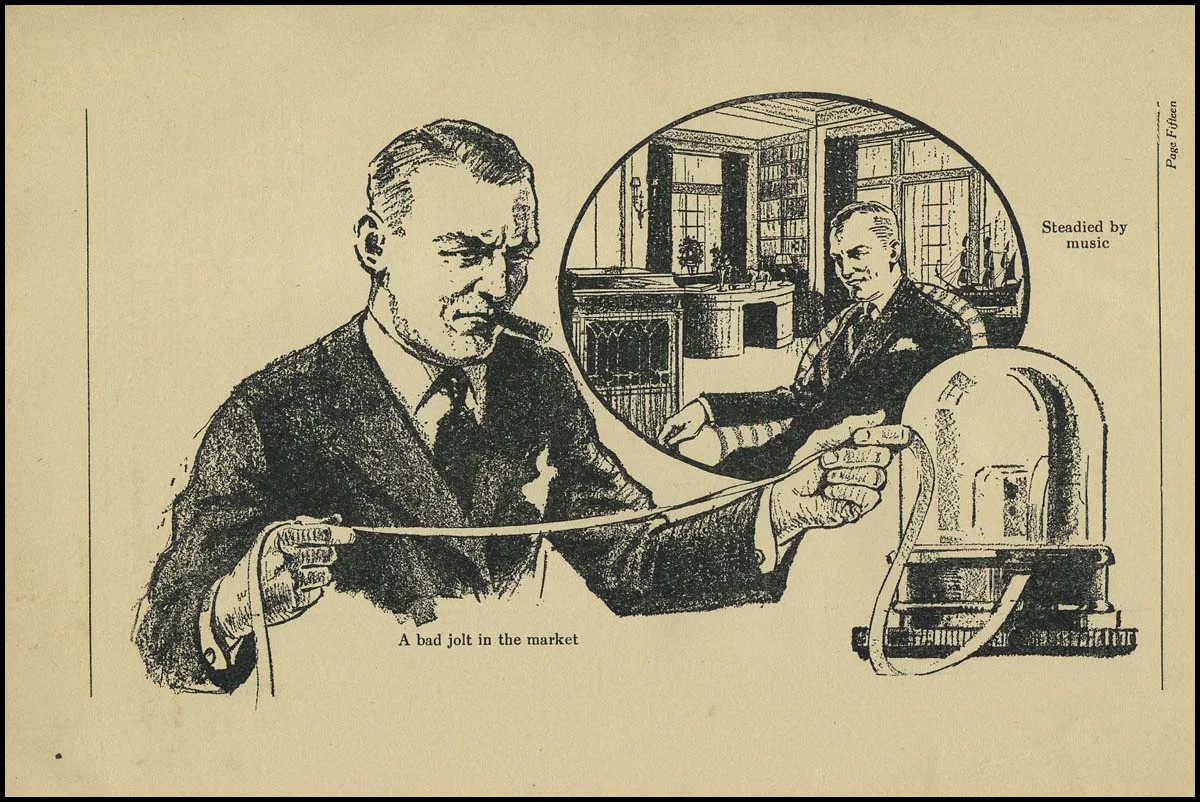
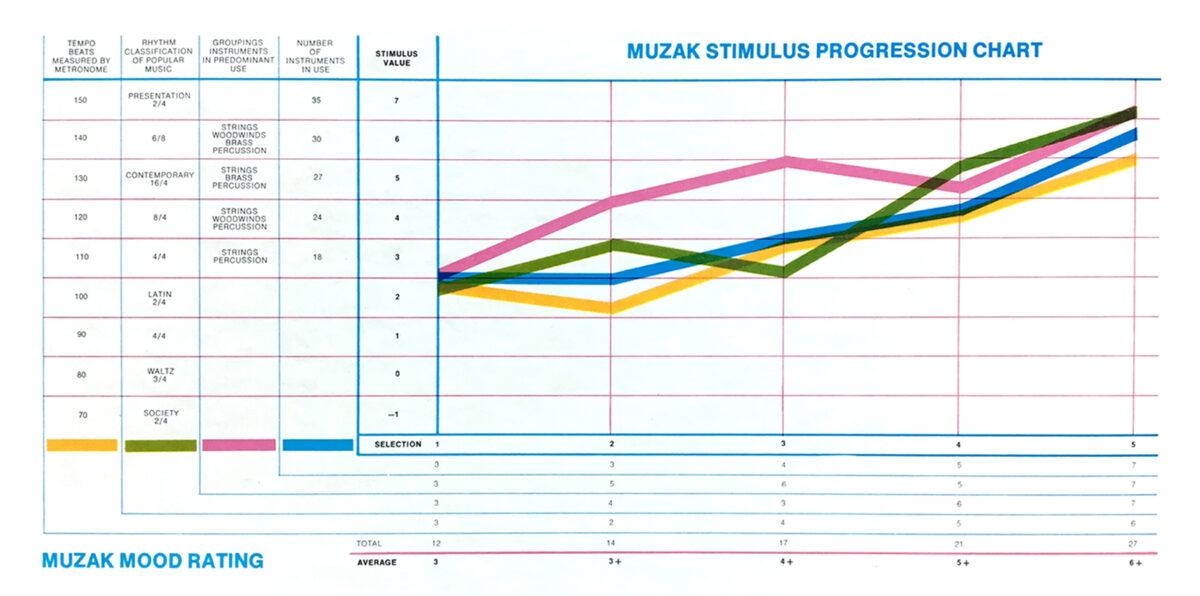
Intertwined with Pelly’s criticism of Spotify’s promotion of lean-back listening are her insights into how Spotify smooths over and commodifies mood with their service, returning again and again to how mood factors into playlist curation, algorithmic recommendations, homogenizing music creation, and shifting the focus of music away from history and community towards a personalized experience focused on how music reflects you, the individual. Alongside these efforts from Spotify are their frequent ties to dodgy pseudoscience that purports relationships between mood and listening that are vapid, vacant, and only serve the commercial interests of the company. These interconnected elements of mood, music, and pseudoscience are not reserved to the streaming era, and Pelly outlines the lineage of this relationship from Thomas Edison’s Mood Music publications (seen in this post’s header image), Muzak and Stimulus Progression, and New Age, particularly via the Environments series of the 1970s. Pelly concludes that, “Ultimately, mood, vibe, and genre had all just become different ways of tagging music with descriptive data, different ways of sorting music into buckets that served the necessary functions of streaming curation, which is to say, the function that genre has always played: marketing.” She notes how the categorization of nearly everything on Spotify into mood identifiers places limits on and controls how listeners understand their emotions towards the music they engage with, as well as supplies the data that is culled from Spotify for algorithms and advertising.
Appearing throughout each of these discussions in Pelly’s book is how all of Spotify’s efforts to appeal to the lean-back listener and their focus on mood for music’s worth and categorization contributes to the “flattening” of the music industry, or as Pelly points out, the difference between “leveling the playing field” and the field as “leveled.” Spotify’s founders touted themselves as pioneers of creating a democratic, accessible online music space for both artists and listeners, but by fostering a singular environment that forces all styles and creative approaches to fit into a particular mold, music is becoming flattened to cater to a certain sound, genre, or method of creation and promotion. As she writes, “Beneath leveling the playing field is a deeper assumption, too, that artists should want to be operating in a one-size-fits all model—or that independent artists should want to conform to the norms of the winner-take-all pop star system. Data-driven hit-predicting was previously reserved for the stars; now, it was being presented as an opportunity for artists of all scopes.” This landscape places limits on artists, either forcing conformity or increasing invisibility for those who do not conform. There is a sense of loss and regret tied to sacrificing oneself to serve the algorithm. Daniel Lopatin, who works under the moniker Oneohtrix Point Never, poignantly put it best: “If your art practice is so ingrained in the brutal reality that Spotify has outlined for all of us, then what is the music that you’re not making? What does the music you’re not making sound like?” The same could be asked of the music you listen to: What aren’t you listening to because Spotify didn’t recommend it or because you don’t want to affect your Wrapped data? What album were you meant to hear that now isn’t changing your life?
Mood Machine was often a tough read. Not necessarily in that it was challenging, although the book was filled with a lot of dense facts and concepts to wrap my mind around. Rather, it’s disheartening to read that all of the wrongdoing we suspected simmering under the surface of streaming services was true. The music industry is incredibly broken, and as Pelly points out, reflects the failings of broader systems of economic and political power. The realities inside Mood Machine are difficult to face, but for the sake of music, DIY culture, and community, it is required reading. There is no path forward for artists and listeners if we do not educate ourselves on how the current state of streaming services is inhospitable to creativity and community. Pelly concludes the book on a hopeful note, sharing anecdotes about how people are resisting music streaming norms and finding equitable, engaged ways to approach online music culture, including streaming music collectives, public library-based streaming services for local music communities, and European basic income initiatives for artists. She asserts that individual actions such as buying music from artists directly or from a local record shop, attending shows, signing up for artists’ newsletters, and sharing music with friends are still vital ways to subvert the algorithmic empire, but also encourages us to support music labor movements and artist collectives. Pelly writes in the final pages of the book, “On a collective level, we have to be active participants in the cultural economies we want to see flourish; we have to validate the culture we want to see in the world. The corporate culture industry entrenches its power not just through controlling the marketplace but also by controlling the popular imagination, by convincing us that there are no alternatives. The alternatives are growing all around us, though.” Reading Mood Machine ultimately made me feel less alone and more optimistic. Pelly speaks for a growing body of musicians, artists, writers, listeners, record shop owners, and others who recognize these alternatives and are in the process of actively pursuing them in their local scenes. Resist streaming’s conformity. Reject algorithmic alienation. Reclaim your data privacy as a listener. Reach out to your local scene — literally, you can actually touch it.
– Hannah Blanchette
Aside: I purchased my copy of Mood Machine from Downbound Books in Northside, and you can also get it from Cincinnati’s public library and Chicago’s public library. I am pleased to say that all the copies are checked out right now.
May 22, 2025 | Blog