
Complicating Silence with Brian House’s ‘Everyday Infrasound in an Uncertain World’
I made it a point the past week to bundle myself up tightly and go for snow walks each day after the blizzard that a large portion of the country received. A significant part of why I crave snow walks is because I am awestruck by the characteristic silence that descends upon a place when it snows. There is nothing like obstructed driveways and clogged, powdery roadways to momentarily make the world seem to stop. Even birds almost take a break as the only sound that seems to permeate the air is the crunch of my worn boots slotting into the crevices of packed, uneven snow underfoot. I was shocked at some of the sounds that did manage to sneak into the landscape – a set of wind chimes more suited to a summer breeze than a frigid chill, a lone shoveler scraping and striking the accumulation, ambitious sledders calling out to one another as they trudged up the hill. In the aftermath of these snow walks, I found my ideas of silence challenged when I came across Brian House’s Everyday Infrasound in an Uncertain World, released last year on Gruenrekorder. Listening to House’s record and learning about its background reminded me of John Cage’s adage in the experimental music world: there is no such thing as silence.

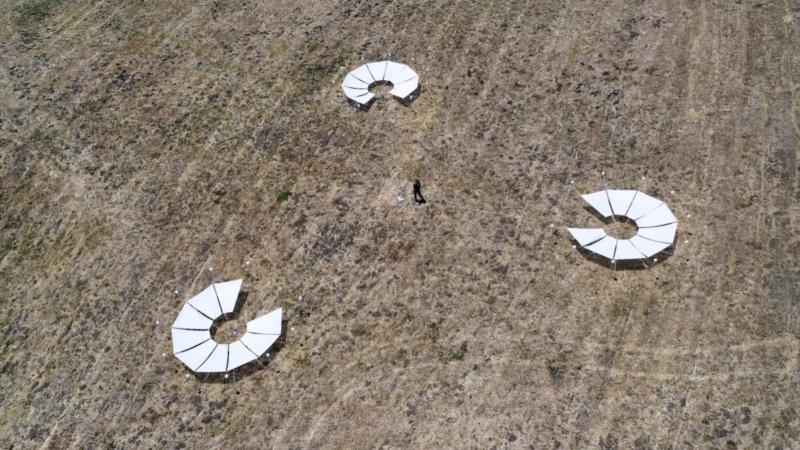
Brian House, an artist and professor based in Amherst, Massachusetts, focuses with Everyday Infrasound on the constant sounds around us that escape our possibilities of perception. The term infrasound refers to incredibly low frequencies that lie beyond the limits of human hearing. Both natural and manmade infrasound emits from the world daily, from industrial machinery to ocean currents. House built devices called macrophones to capture this infrasound, as ordinary microphones don’t have the capacity to do so. After gathering the sounds via the macrophones in Amherst, House sped up the twelve-hour recordings into two twelve-minute tracks, one that documents daytime, and the other night. House’s impulse behind this work lies heavily with reflecting on climate change, as he finds that these hidden sounds, whether they be glaciers melting or storms raging, depict these seismic events of the Earth. He told The Amherst Student in 2023, “…The question is, if we can hear the sounds that are being made by these phenomena, would that change our relationship to the planet?” Ultimately, House believes the macrophones are most suited to an installation so that individuals can hear the infrasound emitting from a particular space. Even the idea of attaining a glimpse of what infrasound could be emerging from my immediate environment made me reconsider why I crave silence and how silence is not even a natural occurrence.
Even though I have contemplated the nonexistence of silence ever since I learned about John Cage’s 4’33”, I still find myself craving it and believing in its existence as if it were a myth or fairy tale. The silence I seem to yearn for is not the complete absence of sound, but simply a less chaotic and more focused environment of sound that can be hard to come by in the world’s unabating stimulation and chatter, a type of quiet that allows me to hear only the crunching of my boots on snow. But of course, that is not silence, even if it feels like it. House’s documents of infrasound complicate the idea of silence even further. Even if someone does feel as if they have achieved an environment of complete silence, there will always be sounds underneath the surface, frequencies of constant phenomena coursing through the atmosphere. There truly is no such thing as silence, and the Earth itself proves it.
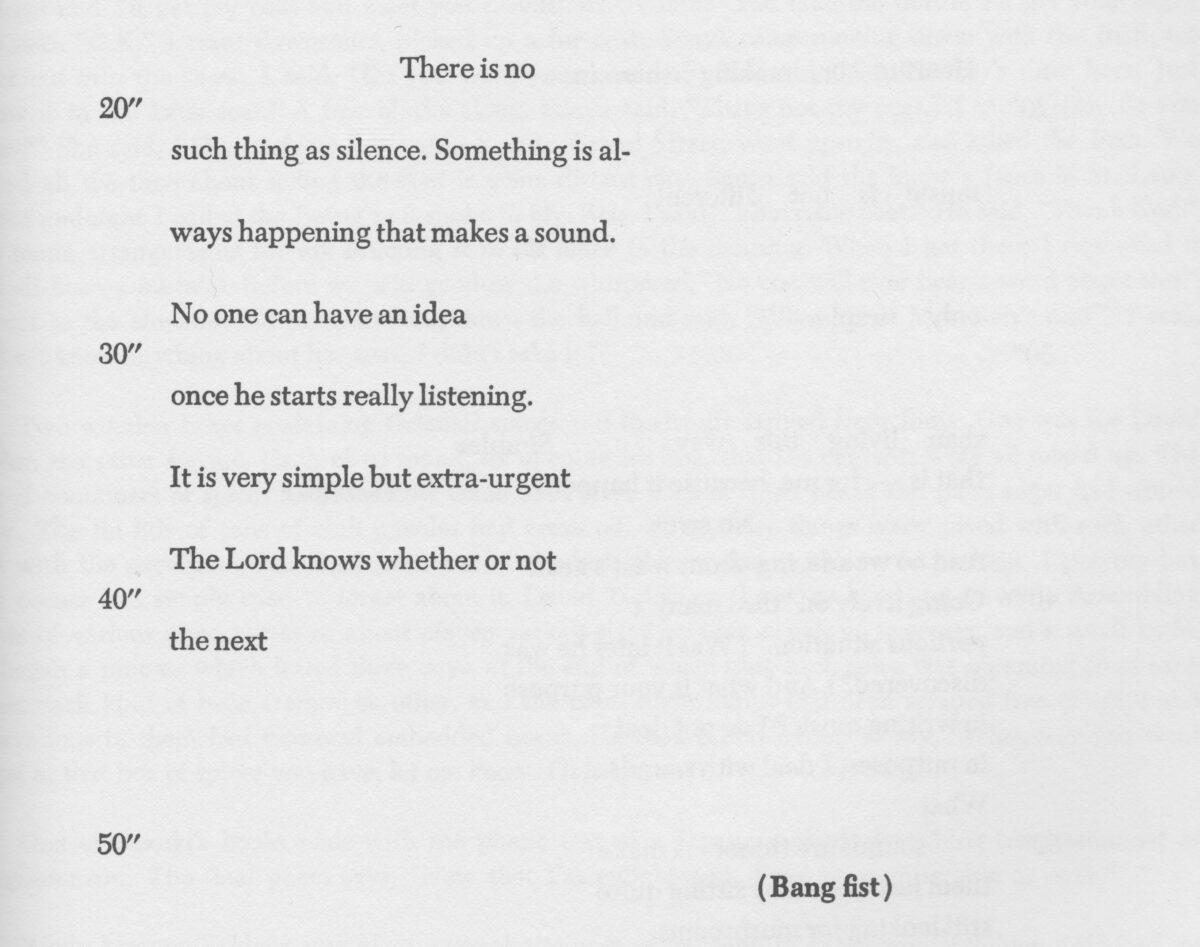
The phrase, “no such thing as silence” is derived from Cage’s work “45’ For a Speaker.” Near the end of the piece, it is written, “There is no such thing as silence. Something is always happening that makes a sound. No one can have an idea once he starts really listening.” Cage certainly was referring to the fact that if you listen, there are always sounds that contribute to the fabric of our surroundings, ones that we often tune out to favor others. “45’ For a Speaker” came about around 1954, and three years later, French scientist Vladimir Gavreau began investigating the existence of infrasound. House’s work takes Cage’s ideas one step further than Cage could have imagined at the time: “Something is always happening that makes a sound,” even if you physically cannot hear it. But it still exists.
Not only is the idea of silence artistically limiting, as it disregards the spontaneous ambience that contributes to an aural landscape, House’s Everyday Infrasound proves how anthropocentric the idea of silence is. Even though as hearing humans we may perceive silence, there is always the Earth’s sounds permeating space, and acknowledging infrasound removes humanity as the crux for measuring what sounds are valuable. House makes a point of how experiencing infrasound transforms not only one’s relationship to sound, but also to physical space. He told Everything is Noise that, “…Infrasound is not only low; it is distant. That is, these long wavelengths (like a mile long) can travel vast distances through the atmosphere—even all the way around the globe. Knowing that, I feel that hearing these sounds changes my relationship to the planet as a whole.” Often, I find that when I perceive “silence,” it is understood as reflective of my immediate environment. In reality, there is infrasound around me that illustrates the movements of places I maybe have never seen and which could be experiencing a completely different moment from my own. This idea of vast interconnectedness through sound is destabilizing, a fitting descendant to the subversion which Cage sought with his views on silence.
Going forward, I want to better distinguish between quiet and silence in my desires. By the philosophy of Cage and the documentation from House, silence is a useless pursuit when it does not exist. Quiet might not even be what I’m looking for, but perhaps more of a chance for deep listening, along the lines of Pauline Oliveros’ theory. While I won’t be able to naturally perceive infrasound no matter how deeply I listen, the acknowledgement of its existence coursing like a current beneath my feet and through my body will remind me that there is much on this Earth beyond what I can observe.
– Hannah Blanchette
February 2, 2026 | Blog