An Evening with the East Coast Harp: Mary Lattimore at the Woodward Theater, March 11, 2026
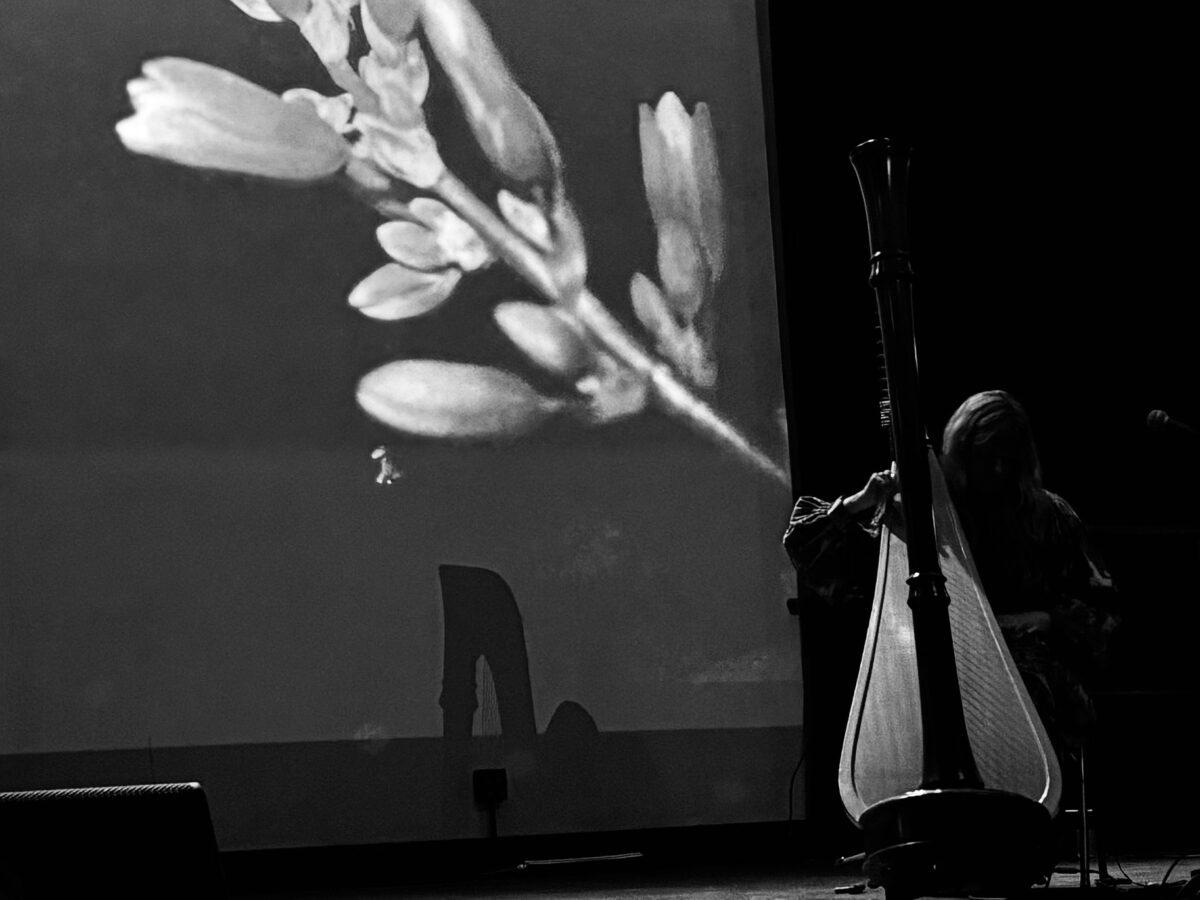
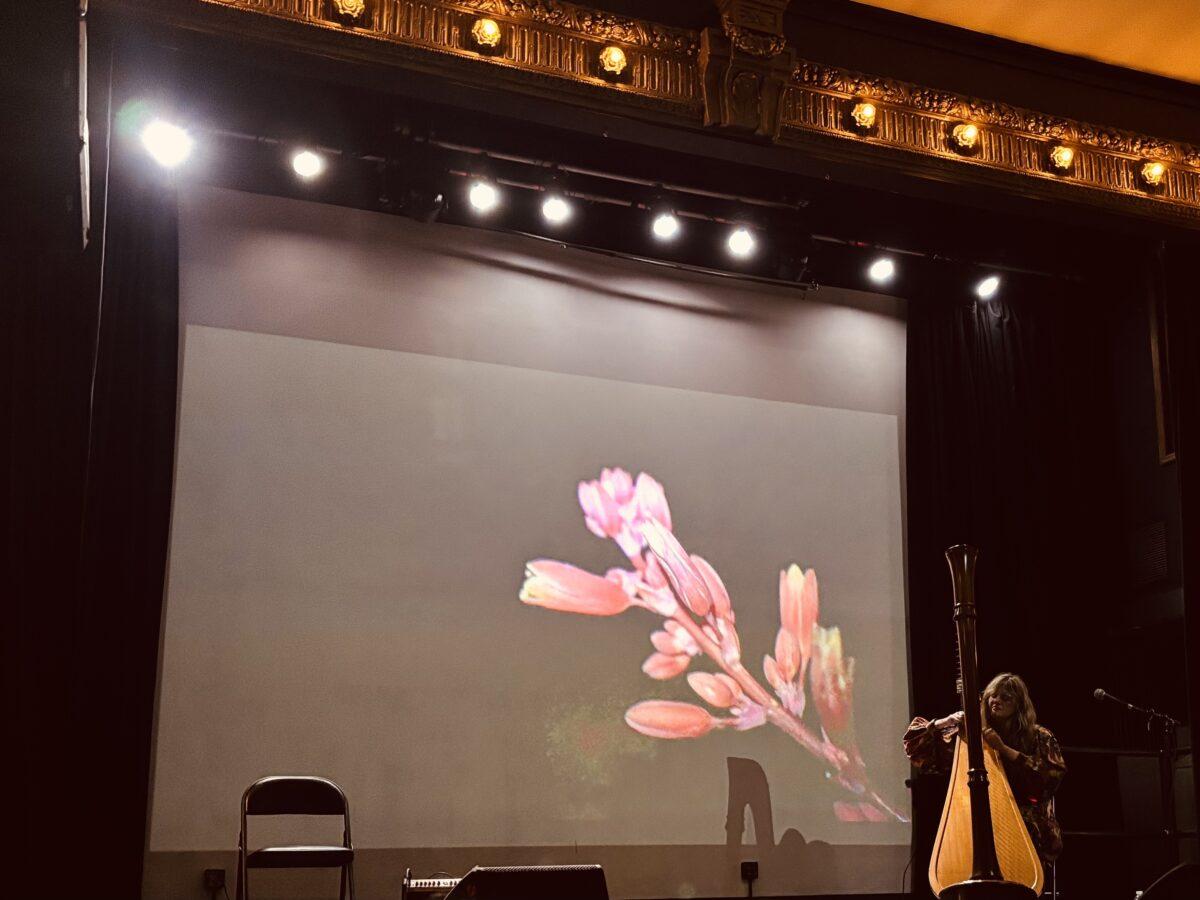
When I arrived for Mary Lattimore’s appearance at the Woodward Theater a couple weeks ago, the room was transformed from the sweaty, wide-open pit I experienced for Snõõper. White folding chairs spread out across the floor in rows, preparing the space for the transcendent compositions from the LA-based harpist. The mood in the room was light and jovial as old friends caught up with each other’s lives before the concert began. All of this felt appropriate in the end, as I was delighted by Mary Lattimore’s presence onstage as not only a phenomenal harpist and composer, but also as a storyteller. Each of us in that room converged to that one place, all stories meeting to intertwine with Lattimore’s tales for one evening.
The concert was opened by Planchette, the project of local experimental cellist Nora Barton. Barton organizes ambient jam sessions in the city, but tonight she was spellbinding the audience all on her own, cello in hand and a robust collection of pedals at her feet. The beginning of her performance blurred the line between tuning and the piece’s start, which I always love because it challenges that commonly strict boundary in the classical concert hall. She struck her tuning strings with a meditative, droning quality until the appearance of spectral harmonics with her bow eased the audience into the performance proper. Planchette often heavily uses delay in her works, and the way the overtones overlapped with this particular delay gave them an ethereal quality as if they were ghostly voices. They immediately brought to mind the offstage female choir which concludes “Neptune” from Gustav Holst’s The Planets, the seductive sounds of sirens of the sea beckoning the listener underwater.
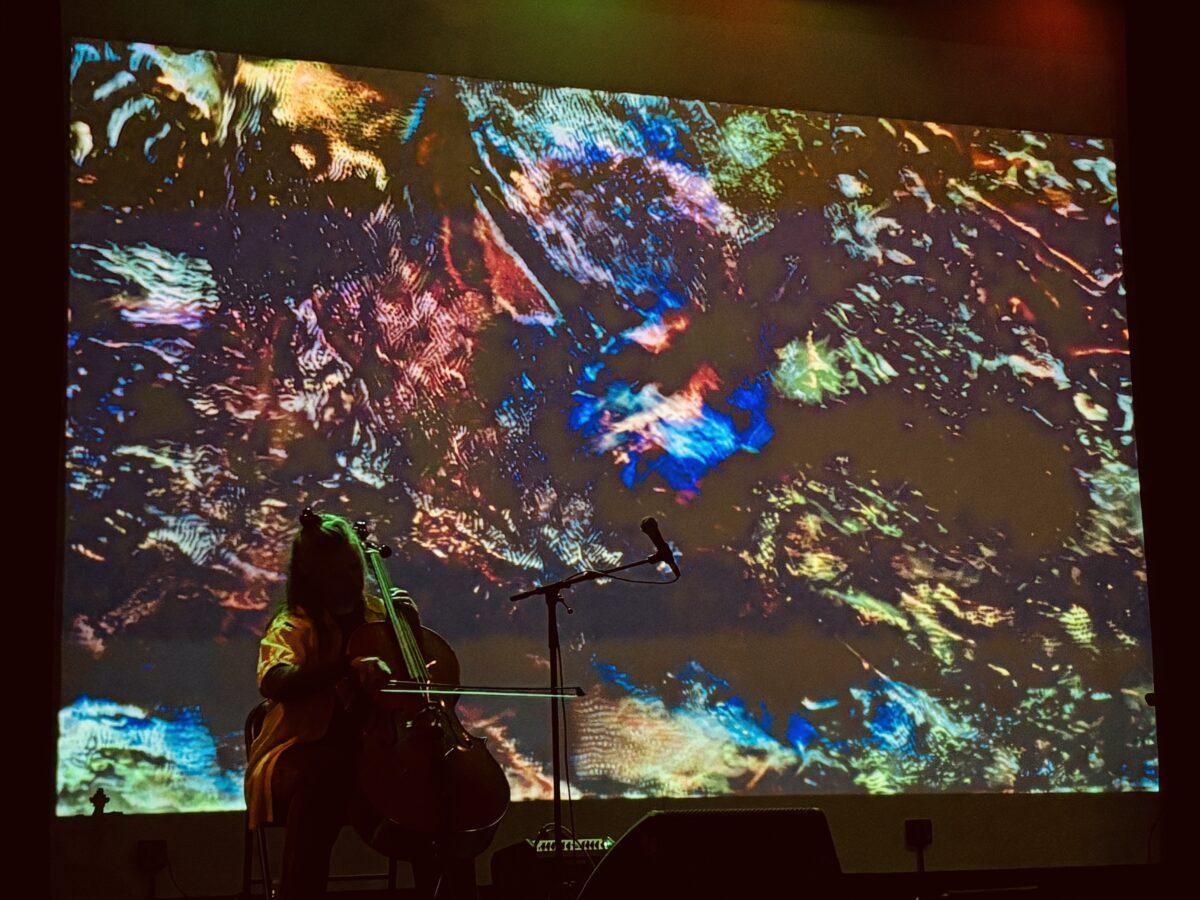
These gentle tones soon transformed as Barton’s bowing intensified, applying full pressure on the low strings to create a menacing quality. With this full tone, her cello sounded as if icebergs were shifting in the dark abyss. But just as her improvisation took this darker turn, the heaviness shattered into little shards, contemplative pizzicato that morphed into a flurry with the delay pedals on, akin to honeybees buzzing around a hive. The delay continued to weave the pizzicato together, forming an astral patchwork of plucks that Barton soared on top of with these aching lines. What I assume was the activation of an octave pedal added a shimmering layer on top of these lines, the delay causing the ends of phrases to fall off the edge with a wail. These yearning motifs eventually begin to escalate into a frenzy, the sound of the bow slicing into the string cutting through the trance I was previously in. This mayhem eventually bursted into the final remnants of harmonics and delay, like the detritus from the death of a star.
After one more improvisation from Planchette and a short break, Mary Lattimore’s set began in a cheery tone, with an intimacy as if we were all seated together for a salon concert. Lattimore introduced herself and what she called her “East Coast Harp,” named Princess. This concept of the East Coast Harp fascinated me, as I’ve only ever played comparatively small instruments to the harp, and I never thought about the challenges of traveling with an instrument of that size. With Princess at the ready here in the EST, Lattimore described how this first visit to Cincinnati was kicking off a long period of touring for her. The first piece Lattimore performed created this thick tapestry with layers that she continually added to a loop, over which she played these plaintive lines across the top. The motifs chugged along, yet seemed to float at the same time. This initial performance set the standard for her technique throughout the concert, this gradual building of textures fragment by fragment. I sat there and marveled at how she could introduce each tiny element into the loop, precisely synced in time and working to build this greater whole, as if she was building a puzzle and knew exactly where each piece needed to go. Lattimore’s pedalboard sat in her lap, and there were moments where she wouldn’t even touch the harp, but simply electronically manipulate whatever she had woven already.
Once Lattimore’s set progressed, I started to try jotting down every title she mentioned she was playing, not only for my records, but also because she had a unique backstory behind every single work. At this point, Lattimore was like a troubadour, a traveling storyteller through song, spinning tales as much as she did music. Each story behind her compositions were so reflective of the intricacies of life, the little and big things that occur which shape how art is made. The first of these stories was about how the next piece, “On the Day You Saw the Dead Whale,” was inspired by a dead whale Lattimore encountered on the beach while doing a residency in San Francisco. She was overcome by the magnitude of the natural phenomenon she was witnessing, but also saddened by the loss. At this time, Lattimore was staying at a residence with no WiFi, which helped her direct her attention towards the harp, and the focus that place afforded her shaped this composition. Again, it was this combination of a monumental moment, such as coming across a deceased sea creature, with the simple technicality of not having Internet access, that made this story, and her others, feel so grounded and real. Her music came forth within the context of these stories as snapshots of life, in all its grandeur and banality. This particular piece relied heavily on the harp’s low strings, which were incredibly resonant and rattled my chest. She added to this tone a pulsating effect that felt like a flip book flickering in my mind. Not for the last time in the evening, I completely lost myself in the music, sat back with my eyes closed as if I plunged myself into sensory deprivation.
The next story Lattimore told was one of my favorites, in which she described “For Scott Kelly, Returned to Earth,” written for the astronaut who broke the record for the longest consecutive time spent in space within a single space flight at 340 days from 2015 to 2016. During this time period, Lattimore had her jaw wired shut, and she experienced a kinship with Kelly and the isolation that comes from not being able to communicate in a traditional way. He came back down to Earth around the same time that Lattimore’s jaw healed, their journeys concluding in tandem. She even sent NASA the piece to pass along to Kelly, who enjoyed the work and, Lattimore added with a fond chuckle, used the song in a PowerPoint presentation. For being a piece about returning to Earth, it was still cosmic, with Lattimore adding burbling electronic effects to a rhythmic harp part.
One of the most memorable selections of the evening was the darkly nautical “Til a Mermaid Drags You Under,” which was based on her time spent in Cornwall during the winter. I love visiting coastlines and beaches in winter, and while I listened to Lattimore’s performance, I could visualize overcast skies, dense fog, and churning waters that catapult droplets of frigid mist into the atmosphere. Lattimore brought this to mind with this unnerving composition, in which she plucked the bass strings of the harp with such force that the string would slap back and clatter. She also knocked on the harp’s wood, and the overall effect was like hearing something rustling in your walls. It also seemed as if she was bending the strings, which created this woozy sensation as if you were walking aboard a careening, unstable vessel. As the song progressed, the knocking sounds became more frantic as they all incorporated into the loop Lattimore was making, and she introduced a very high, wispy, and spiky melody at the very shortest of the harp’s strings. I noticed that in Lattimore’s works, she used these very classic, traditional harp gestures, such as a broad glissando up the strings, but toyed with and manipulated them in such compelling ways with her pedalboard, challenging your notions of how a harp sounds and what it is capable of.
As the remainder of the performance transpired, I was simply in awe of how adept Lattimore was at her craft. She combined absolute technical dexterity with the knowledge of how to spin each note into vast compositions on her own, all while bringing in interventions from electronics. Everything was also happening in real time, unfurling like a fern with precision and ease. Perhaps most special of all, there were so many moments when I caught a glimpse of Lattimore with the most blissful grin on her face, as completely enraptured in making her music as we were listening to it. There is little that is more life-giving than being unified in that way between audience and musician, with the music that tethers the two together summoning equal amounts of joy for all.
– Hannah Blanchette
March 27, 2026 | Blog