The Musical Object as Conduit for the Personal, from Artist to Audience
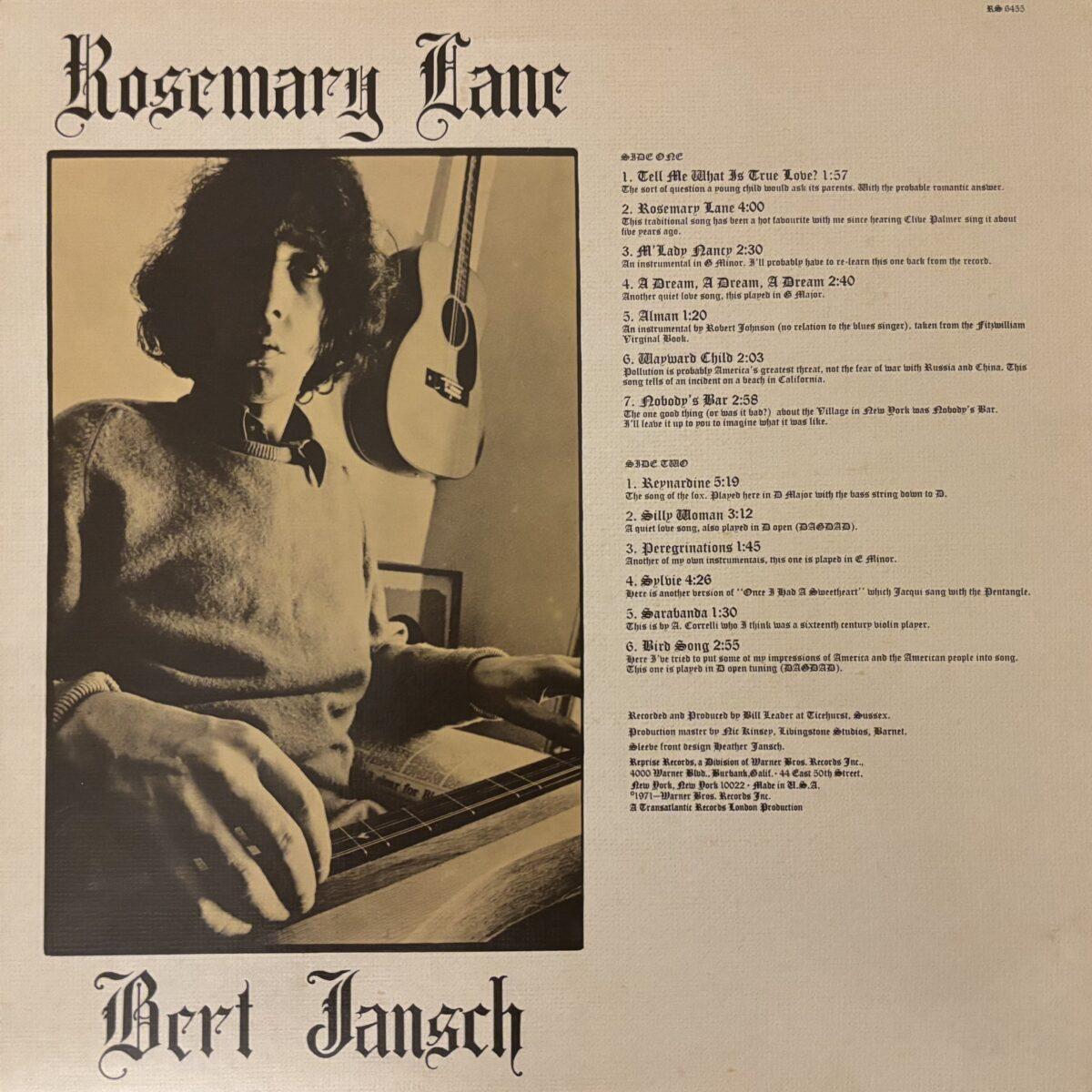
I took a trip to New England during the first week of August, and despite my common sense repeatedly reminding me that I had limited room in my carry-on for lugging back souvenirs, I inevitably returned with every crevice of my luggage stuffed with books, DVDs, and one vinyl record precariously placed inside my backpack. The record was a last-minute acquisition from the morning of my return flight, as I could not resist stumbling into the hole-in-the-wall record store I swore to abstain from. I planned to only leave with a CD or two that I could drop inside my bag, but convinced myself I could fit a whole LP instead when I happened upon my find. I noticed the shop had a special tab for all the Pentangle, British-folk related artists, including a special tab for Bert Jansch. Outside of a wonderfully compiled Bert Jansch CD I own, my Jansch collection is woefully empty, and I constantly search to fill the gaps. On this day, I located my first Jansch LP find — Rosemary Lane from 1971, one I had been particularly on the hunt for for years.
Because I caught my flight only a few hours after purchasing Rosemary Lane, I didn’t really get a chance to look the record over until I got back. Looking closer at the back of the sleeve, I was delighted to find little descriptions attached as comments underneath every single song title. Some are simple and straightforward — “Peregrinations: Another of my own instrumentals, this one is played in E minor” — and others are specific to the song’s meaning — “Wayward Child: Pollution is probably America’s greatest threat, not the fear of war with Russia and China. This song tells of an incident on a beach in California.” At times his descriptions are charmingly self-deprecating — “M’Lady Nancy: An instrumental in G Minor. I’ll probably have to re-learn this one back from the record” — and many are personal and conversational — “Rosemary Lane: This traditional song has been a hot favorite with me since hearing Clive Palmer sing it about five years ago.” I had so much fun sitting there for a few minutes reading through Jansch’s insights into the songs on his record, and some of the information was rewarding as a guitarist too, such as his sharing of which tunings he used for some of the songs. Through these sentence-long snapshots, I caught a glimpse of Jansch’s character and attitude as a musician, as well as his tastes and interests at that exact moment in time.
Connecting with Jansch’s song descriptions reminded me of many moments on physical records where artists share pieces of themselves and use the musical object as a way to connect with their listener, creating a bridge between creator and audience. Kate Bush had an eager, “Hope you like it!” etched into the matrix of her 1978 record, Lionheart. Extensive album notes emblazoned the covers of classical and modern composition records, providing expert knowledge into the composition and recording of the pieces, to the point there was even a book published compiling these covers, Classique: Cover Art for Classical Music. I realized that as music shifted from the physical to the digital, the personal became detached from the musical object. The album itself, or zines or fan club newsletters (Kate Bush’s were notably intricate and quirky), were no longer the places to house intimate details about the album’s creation and creator, but instead those personal connections moved onto blogs, newsletters, and social media.
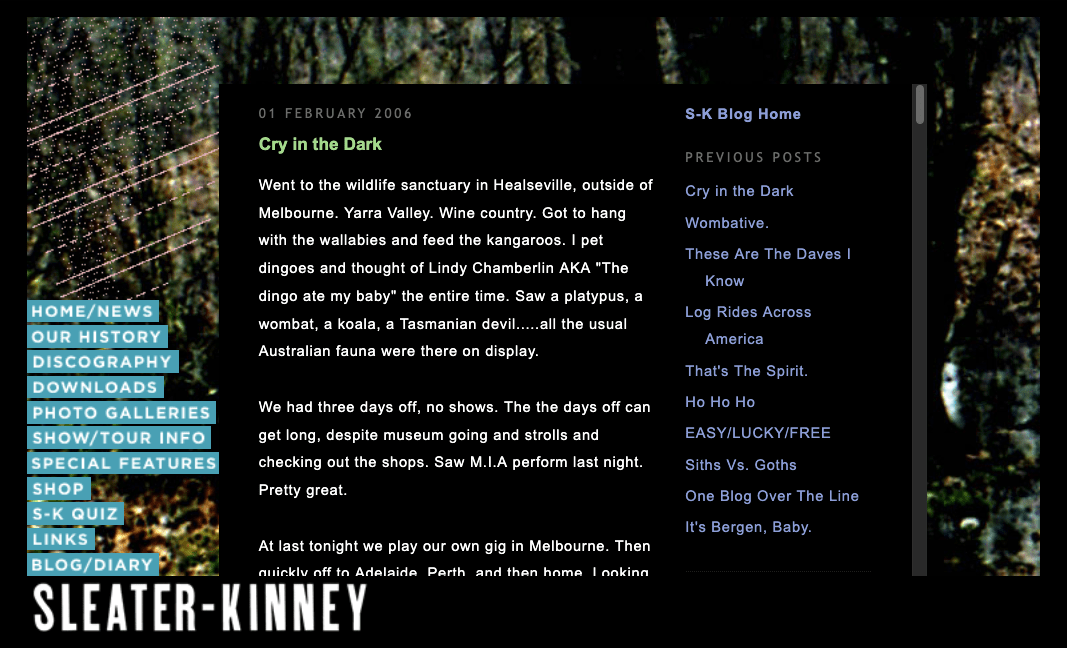
While I am certainly an enthusiast of physical media and am often critical of its digital counterparts, I don’t believe this shift of an artist’s personality from physical media to digital is wholly a good or bad thing, but a combination of both. For one, digital expressions of self such as blogs or email newsletters can be bursting with imagination, serving as alternative creative outlets for artists that become as imbued with meaning as their musical output. On the Wayback Machine, I once saw how in the early 2000s, Sleater-Kinney kept a tour diary on their website, and a GQ article from 2021 about Perfume Genius’ eccentric email newsletters cited his as a standout amongst many artists adopting the newsletter format to share pieces of themselves with audiences, including Jeff Tweedy, Patti Smith, and Neko Case. And I do believe that these types of digital expression from musical artists are still substantial and deliberate, often conveying thoughtful insights into an artist’s musical process, tastes, and ideas. On the other hand, I still find that social media is often (thought not always) more shallow in its offerings from artists, serving as a fast and easy platform to market oneself rather than a place to ruminate and circulate ideas.
The other, oddly positive byproduct of the mainstream shift from the physical music object to the digital is that many artists and labels have put more effort and care into creating the physical music object because it is no longer utilitarian, rather something that stands apart from the daily doldrum of digital music usage. Put bluntly, records are special, and the proliferation of the personal in online spaces has not entirely diminished the presence of a personal touch on physical records today. Still, it’s so rare and exciting to stumble upon a record like Jansch’s, one that speaks out from the musical object to the audience as if the listener were a friend. It almost felt like Jansch had passed the album to me as a mixtape and these song descriptions were little asides he scribbled on the J-card. Finding commentary like Jansch’s on a record makes you linger and care about the music and the album for a little longer, and turns the album into a time capsule in itself of everything surrounding the record in those moments. While it can be fun to connect with artists via social media or their email newsletters, as with everything else on the Internet, it can seem ephemeral to a fault. The physical musical object can hold so much more than music, and it’ll all stay there, waiting to be rediscovered and shared, again and again.
– Hannah Blanchette
August 18, 2025 | Blog