
Songs to Ignite: Eccentricity, Religious Music, and How We React to the Work of Sister Irene O’Connor
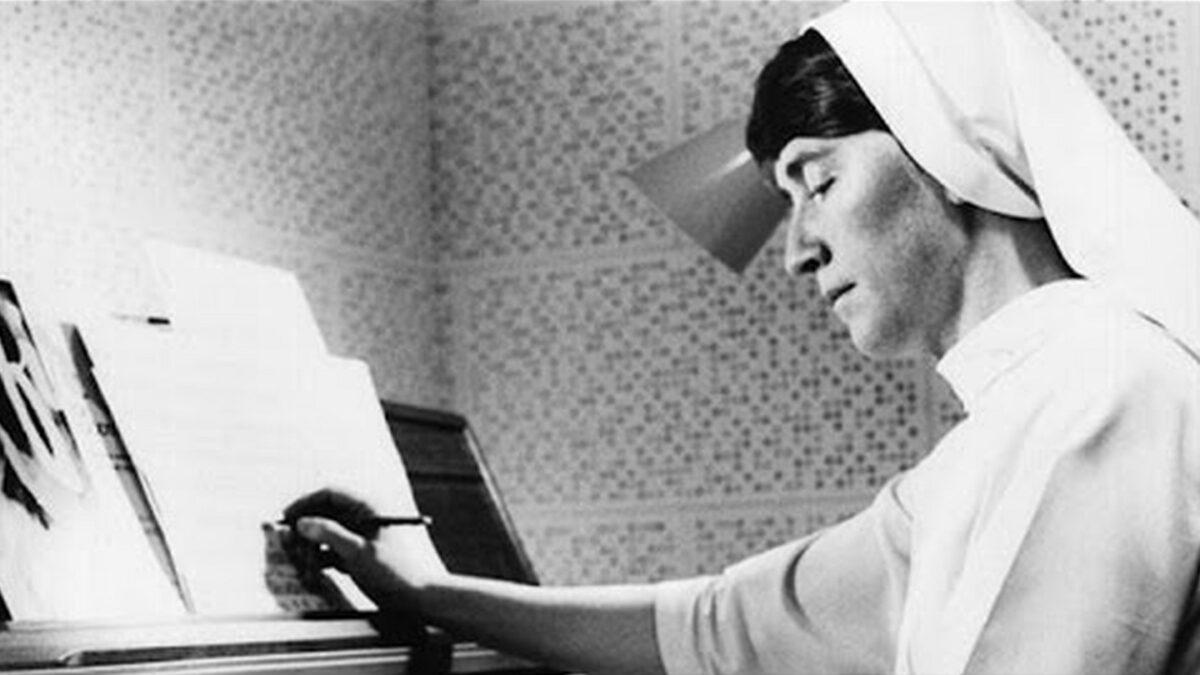
In a couple weeks, Freedom to Spend will reissue Fire of God’s Love, the offbeat, psych-religious release by Australian nun, Sister Irene O’Connor, available for the first time on vinyl since 1976. Sounding like a lost Broadcast recording or if Pentangle employed more early synths and drum machines to their sound, O’Connor’s record combines religious texts with a psych-folk instrumentation of guitar, electric organ, synthesizer, drum machine, and O’Connors’s echo-drenched vocals. After reading the announcement about this reissue, I dove into research to dig up what I could about O’Connor and the history of Fire of God’s Love. While I was not able to uncover much about the enigmatic nun and her musical parter, Sister Marimil Lobregat, I was intrigued by the blogs, articles, and write-ups I was able to find, and the different lenses writers and listeners use to conceptualize O’Connor’s work. Some view Fire of God’s Love as the byproduct of a completely uninfluenced miracle of psychedelic genius, an anomaly that was ahead of its time akin to how individuals view outsiders like The Shaggs. Others focus on the confluence of the sacred and the secular in O’Connor’s music, how secular listeners encounter O’Connor’s craft, and vice versa, how the nun brought the aesthetics of a musical movement associated with drugs, youth, and counterculture to sacred texts. Do these perspectives help situate O’Connor’s work in the lineages of psychedelic, outsider, and lo-fi music? Or can they limit how we analyze Fire of God’s Love, which may actually accurately represent O’Connor’s musical experiences and a nun’s paradoxical life of both solitude and community?
In the 1960s, Sister Irene O’Connor traveled to Singapore as part of the Franciscan Missionaries of Mary, a Roman Catholic Order based in Australia. During this time period, nuns frequently visited Singapore as a part of their missions. O’Connor taught kindergarten for children with learning disabilities there, and one day decided to incorporate singing and playing guitar into her classroom activities. The children adored the music, and O’Connor began to embrace music as not only an educational tool, but also a conveyor of religious concepts. She recorded multiple albums while in Singapore under the alias Myriam Frances, dating back as early as 1966, and she also provided music for educational records released by the Sydney Catechist Center.

Fire of God’s Love was kindled when O’Connor reunited with an old friend of hers from her time in Singapore, fellow Franciscan nun Sister Marimil Lobregat. They both ended up working at the same convent in Sydney in the 1970s, and were a complementary pair: O’Connor held a new batch of songs waiting to be recorded, and Lobregat was an experienced audio/visual technician at the Catholic Audiovisual Center in Homebush. The duo recorded Fire of God’s Love together across several Sundays, capturing the audio either in a small room at the convent or at the Audiovisual Center. One of the distinctive, and particularly psychedelic, qualities of the album is its reverb and space echo effects. The nuns had actually tried to create these effects naturally by recording the opening track, “Fire,” in a bathroom, but a barking dog kept interfering, causing them to use a reverb machine instead. The record was released in 1973 in Australia on Philips, and was later released in the United States on the Alba House label in 1976, but the record only sold in small quantities, mainly distributed within the Franciscan Missionaries of Mary community. Fire of God’s Love was the only release that O’Connor and Lobregat worked on together.
Over the decades, Fire of God’s Love faded into obscurity until the crate diggers of the Internet brought the record back onto turntables (and also circulated it as free mp3s in the golden age of music blogs). WFMU’s Beware of the Blog, which posted from 2005 to 2015, shared Fire of God’s Love in 2010, and the blog entry stands as an oddball artifact of how devotees of outsider music reacted to hearing Sister Irene O’Connor’s curious, psychedelic invocations of Biblical scripture for the first time. Outside of the myriad of individuals in the comments sharing their admiration for the record and craving downloads, there was also a trend of people expressing their incredulity at the unexpected nun behind the tracks. Chris wrote, “If I didn’t read first Id’ve thunk it was some hipster chick from Brooklyn or San Fran doing these songs,” and Mark had a similar reaction to mine: “These tracks could be the demos for the next Broadcast album.”
Another common trend in how writers consider Sister Irene O’Connor’s work is a frequent thread in outsider music — the originality and innovation behind the compositions is reflective of a musician working outside the standard circles of musical influence. In Far Out magazine a couple months ago, Reuben Cross wrote that, “considering how those who have taken a vow of poverty, chastity and obedience to the Lord sometimes live in cloistered communities that shield them from external influences, it could be considered unusual when someone living in a convent ends up dedicating themselves to creating otherworldly psychedelic records.” Cross later adds that O’Connor presented “a singular focus on making devotional music, and with that comes no pretense or exhibits of self-consciousness.” These statements attribute much of O’Connor’s ingenuity to the small, intimate, and assumed musically isolated circles she would have frequented, as well as to the fact that she approached her music creation without inhibition due to her specific vision. I do believe there is some validity to this perspective, and I think it especially explains the popular fascination with O’Connor. Listeners find her psychedelic devotionals particularly intriguing because of this unexpected convergence of the sacred and the secular, and the unorthodox source of the tunes from inside a convent. These elements add a mystical quality to the music, because O’Connor would have been so far removed from Haight-Ashbury or 13th Floor Elevators.
The other trend that emerges in how O’Connor’s music is analyzed is a recurring one in discussions of lo-fi music — that the rough, lo-fi, and DIY approach to O’Connor’s recording with Lobregat adds to its authenticity, charm, and allure. Pablo Iglesias González acknowledges in the El Muelle 1931 shop’s blog how O’Connor’s album is a testament to how “the most intriguing music comes from those who aren’t trying to make history but simply expressing their truth with their available resources.” González makes a point of how Fire of God’s Love represented O’Connor and Lobregat, without outside interference, simply using what was at her disposal to create the album, which also translated into compelling early electronic experimentation through the use of synthesizer, drum machine, and reverb. It is interesting to think about how drum machines, for example, are revered equipment of the lo-fi sound, when they are often simply authentic representations of a musician needing to provide a beat to their work without the aid of a drummer.
A blog post on Rarebird’s Rock and Roll Nest quotes Brad Reno’s Trouser Press Record Guide to point out the plethora of oddball religious records hiding in record bins to this day, spanning releases from what he calls, “a cast of characters ranging from snakehandling hillbillies, housewives, pre-teen evangelists, preaching hand-puppets and tiny church choirs.” He also notably remarks that “almost all of it is unpolished and primitive.” Rarebird’s author goes on to note how a lot of this music, Sister Irene O’Connor’s included, marks a time before Christian music became sleeker and more highly produced in the 1990s. In a similar vein to the praise of Fire of God’s Love’s lo-fi qualities, both of these writers glorify the days of religious records that were a bit rougher around the edges, and perhaps a little more eccentric.
While there is value to both these outsider music and lo-fi music stances on receiving Sister Irene O’Connor’s work, I also want to present caution that her music isn’t boxed in or subject to assumptions because of these perspectives. Even though O’Connor was in a convent, it is also clear that her life experiences lended much to her musical inspirations. The closing track on Fire of God’s Love, “Keshukoran,” was written in the Malay language during her time in Singapore, demonstrating a clear influence between place and her musical output. Also, the Catholic Church’s musical tradition relies heavily on elements such as drones and singing in modes for liturgical chant, which are also common musical features in psychedelic music, and hinted at on tracks such as “Fire.” So while O’Connor may have seemed like she was so far removed from the psychedelic realm as we know it, we may be projecting that term ever so slightly onto her music. Her music actually seemed to deeply reflect the musical traditions she encountered and was a part of, and demonstrates how interconnected seemingly disparate genres can be.
Of course, we also can’t discount the fact that perhaps Sister Irene O’Connor and Sister Marimil Lobregat are also simply exceptionally creative artists, as well as nuns, capable of innovation simply because of their openness to musical experimentation that can be found in all who make eclectic music. As of about ten years ago, O’Connor was writing meditation music and had composed a musical about St. Francis of Assisi, and Lobregat taught Tai Chi and developed a program of massage therapy for the terminally ill. It seems that no matter what tools they’ve had at their fingertips, or whether they drew from influences or not, the both of these women have a lifelong thirst for creativity so indicative of the perpetual artist.
– Hannah Blanchette
November 4, 2025 | Blog