A Sign of Things to Come: A Conversation with Cincinnati’s Rob Mohan
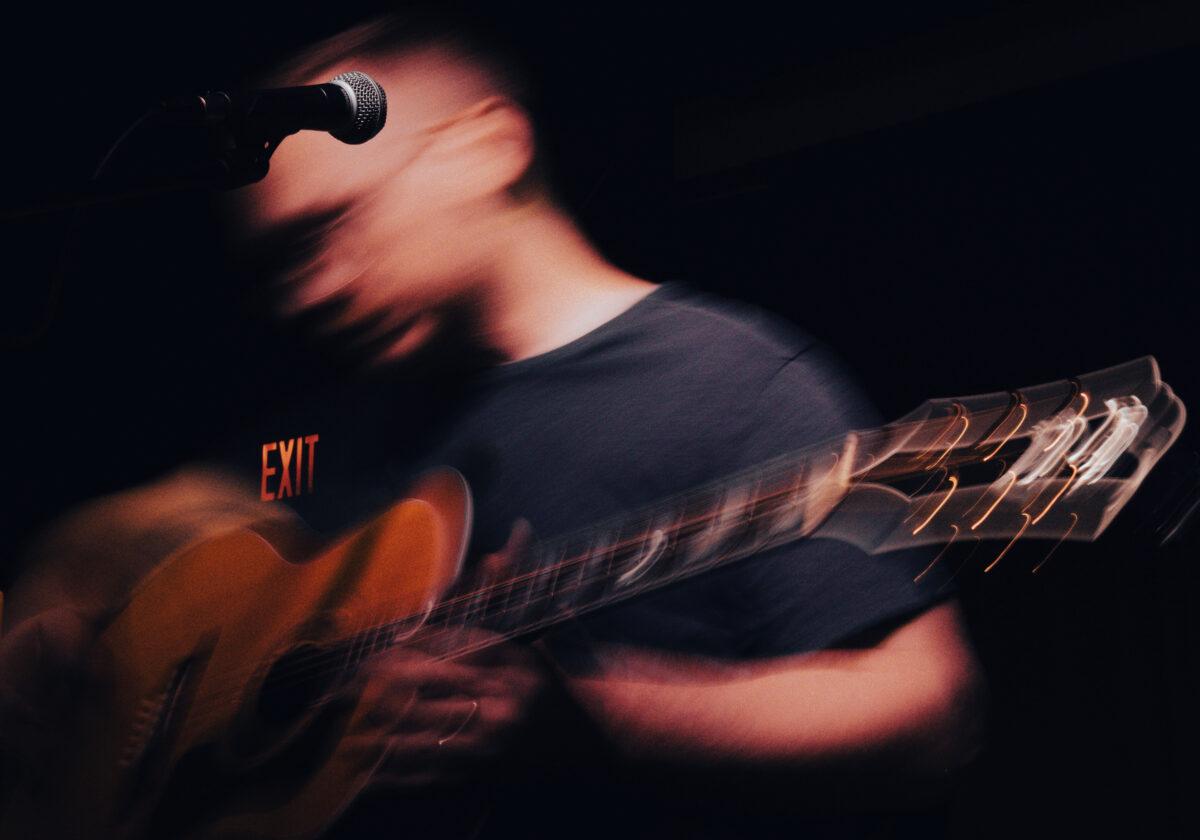
About a year ago, I met up with Cincinnati-based acoustic guitarist Rob Mohan for a chat. Mohan and I have crossed paths in the local scene at various points, and at that time, Mohan had recently started intimating to me that he was diving more fully into instrumental, fingerstyle acoustic guitar. For nearly a decade, Mohan had been performing singer-songwriter pieces under the moniker Night Owl, releasing four studio albums throughout that span. On August 29th, Mohan realized his ambition to release solo, instrumental acoustic guitar under his own name with his release, A Sign of Things to Come. The record is absolutely mesmerizing, an epic of lively, resonating jaunts and intimate plucked numbers, all of which I had the honor of hearing him perform live from top to bottom. The following interview with Mohan, conducted on September 14, 2024, is a stellar look into an artist in process, a musician considering his creative choices in the midst of making them. We discuss the details and the big picture of being a guitarist: the traits of Fahey and Basho, tunings and capos, the way a guitar sounds in a room, interdisciplinary art, and the warmth of the wider American primitive guitar community. Of course, we talked a lot before the recording started and for awhile afterwards, so this interview begins in media res below.
Rob Mohan: I’ve been really getting into some podcasts, around musicians and songwriting because I love hearing about the technique, the frame of reference, the frame of mind. There’s a really good one [by musician Duncan Park], he hasn’t done one in a while, but it’s called Six Strings of Tension, and he interviews a lot of the current American primitive guitar players, like [Daniel] Bachman, Joseph Allred, and others. It’s so interesting to hear others speak on how they got into the whole thing, but then also their frame of mind and what their references are, how they sort of approach playing. I always think that stuff is kind of cool. There’s a bit of a technique and a musicality to all that, but what really drew me to this style of playing is the freedom of expression, coming into it with your own perceptions, your own perspective. You’re not bringing the weight of trying to be classically trained or trying to have all this music theory, it’s more about the inner self coming out through expression. Which is why I really love this kind of music that I’m starting to get into now. When I first started Night Owl, it was very much singer-songwriter-y stuff. I was already influenced by a lot of Fahey and some of the other pickers like M. Ward. But it’s been a gradual evolution. To the point where what I’m working on now is a full-on guitar album.
Hannah Blanchette: When we talked back in March, you hinted that you were wanting to go more in that direction, so I was kind of curious if that was happening right now.
RM: I’m sort of at a crossroads. I’m seeing a split in my creative output to where Night Owl is its own thing where it’s more of my singer-songwriter self. And I’m seeing myself maybe merging off into just going by my name for my more guitar-type stuff. So I activate different modes. There’s Night Owl, for which I have years and years of playing, making albums, and writing songs. And if you go back and listen to my albums, there’s instrumentals on there. You can hear the influences of some of those guitar players coming through, but I’m starting to get into more expression of guitar and expressing myself through the music only and no words. So to me, I’m starting to see a little bit of a split. There’s a lot of players out there that I really respect that do similar things. Like Ben Chasny, Six Organs of Admittance, he does some stuff under his own name, he does stuff under Six Organs. I get the whole argument, you wanna progress a brand and you wanna keep that single line of thread going, right? But I’m not trying to be a rock star. It’s always been for me, and whatever feels right, I’m gonna make that decision.
HB: And Night Owl can always exist if you want it to, it’s something you can come back to. It can be weird to think about, but it is its own entity. It’s its own project. If there’s a point in your life you wanna go back to doing more singer-songwriter stuff, it’ll be waiting there.
RM: There’s something nice about being able to access it if I want to. And I’m not saying I’m going to start playing just under Rob Mohan and I won’t be able to play any Night Owl songs during those shows. Of course that can happen. It’s a freedom of whatever I want to do with that. I played at Conveyor Belt Books, that was my last show a couple weeks ago, and a couple friends were in the audience. And it was interesting because I played most of my set with just my instrumental stuff, and they were like, “Oh, we weren’t sure if you were gonna actually sing during this set or not.” And I wasn’t sure either, you know, it’s just the way that it’s going. But again, it’s just about my evolution as a musician, my appreciation for that kind of music. I hesitate to use terms like American primitive for that stuff. It’s more about accessing a different way to communicate, right? There’s a different sort of mindset when I’m writing songs, when I’m having to write words, versus the freedom of expression that comes out of writing notes. What do I attach to that? What am I trying to say with that?
HB: Yeah, that’s a whole different mode. What do you think has caused this splintering off from words? Because that is one of the main differences here from before.
RM: I think I just wanted to do something different. I wanted to evolve. I think especially in this music scene, there’s a great supply of folk singers that are around, and I’m not putting that down or anything like that, but I felt like I was saying what I needed to say. I was finding myself wanting to dabble more into expressing myself through composition of music and what that means, and I kind of like the ambiguity and the unknown of some of that. The mystery of some of it. I get that with some of my songwriting, too. I’m not always saying concrete words or telling full stories or making it autobiographical. There are abstract themes in the songs that I write. To me, I’m taking it a step further and I’m removing the voice and speaking more through the notes that I’m playing. To me, it’s almost like abstract painting in a lot of ways. You put something down on the canvas and you have something that’s attached to it, but it’s also up to the viewer to also bring what they see in it, or what they’re getting out of it. What’s interesting to me is there’s no words for them to hang onto. It’s more just creating this picture in their mind through a tone, a note, a space.
HB: Lyrics can be kind of abstract, and a listener comes with their own meaning and their own interpretations to that. I think it’s blown wide open when something’s instrumental, it can mean something so different from one person to the next.
RM: Absolutely.
HB: That’s something that’s so fascinating about instrumental pieces. Part of why I like listening to them, too.
RM: And don’t get me wrong, with the whole, singing and playing instrumentals in the same space, you look at Robbie Basho, and he’s gone through many different stages. I think one of the things that I appreciate about him is the cinematic quality to a lot of his compositions and even his instrumental pieces. I appreciate Fahey, as a lot of people, as he was like the intro to a lot of that stuff. But I think that’s more rooted in American pastime blues, things like that. To me, where it really started to get interesting was Basho and some of the stuff that he’s bringing in. He was bringing in Eastern influences, Indian and Native American influences to paint these broad pictures through his guitar compositions. And even when he’s singing on a lot of those albums, it’s beautiful as well.
HB: It’s more expansive with Basho, compared to that intimacy with Fahey. It’s a little different.
RM: Yeah, exactly. That’s a good way to put it. I think Fahey is more like a small room. Everything is about spaces. With Basho, it’s like this grand theater. There’s a lot of playing with echo and reverb, and you get some of that in Fahey’s stuff too. I just feel like Basho is more of a grand scale. There’s a lot of mystery to him. And myself, even starting as a songwriter, I love the mystery. I loved being obscure with words and not being so straightforward, and taking that into music as well. When I really started to listen to Basho’s stuff, it unlocked some things for me from a composition standpoint. Also what themes and how I want to present myself.
HB: I remember that I mentioned Basho after I first heard you. I feel like it was the resonance. You have that very open, resonating tone, similarly that he has. I think maybe the last gig I saw of yours, you started with one of the pieces that you just let it ring out, that’s the connection I can see there. I can see that between your music and his.
RM: It’s making a statement. It’s living in the sounds and what you’re pushing out of the guitar. Again, going back to that idea of Fahey is the small room and Basho, the theater, I do feel like Fahey’s a lot more tight, a lot more syncopated and he does some experimental stuff for sure. But I feel like Basho’s style of playing does a lot more of that openness and letting the notes reverberate, which is cool, which are the things that I like. I like setting the tone. I like adding an emotional quality to it. That’s why oftentimes with the twelve-string I let it ring out, living in the space of the notes continuing. That’s exciting to me. And it’s exciting because, I’ll be the first to say, I’m not out there playing everything note-for-note every single time. So there’s a little bit of free form in there. I get to choose depending on the night, depending on the room, how long I want things to ring out. Do I want to hit the chord, let it ring out, and then feel the vacuum of the silence of the room as it starts to go away? Or do I not wanna be so much on that? There’s a little bit of that dynamic too that’s interesting to me.
HB: In the past, you very much switched between the twelve-string and the six-string. What’s your reasoning behind when you make those switches? This might be mistaken memory, but I feel like a lot of time the six-string is when you’re doing more of your singer-songwriter stuff. I see you use the twelve-string a lot more for the instrumental stuff.
RM: It’s definitely a toss up. I would say the twelve-string comes into play when I do wanna fill the room, right? I think there’s more of a presence to it. I’m a little calculated sometimes in how I set up my sets where I might start with the twelve-string and end with the twelve-string as well as bookends to it. I feel like it makes a statement. And the twelve-string is really just coming from the Basho influence as well. There’s a lot there in what I was hearing, it was like, “Man, how is he doing that? How is he getting that tone? How is he getting that sound?” And it can truly be achieved if it’s a twelve-string. I think there’s a lot about it that gives people pause, a twelve-string is not a very common instrument that you’re seeing out here specifically. I know there’s a lot of players out there that are doing twelve-string stuff, which is great, but here it’s a little bit more of a unique thing. And if I go back to the fact that I’m using this music to make a statement, to make an experience, it’s nice to have that.
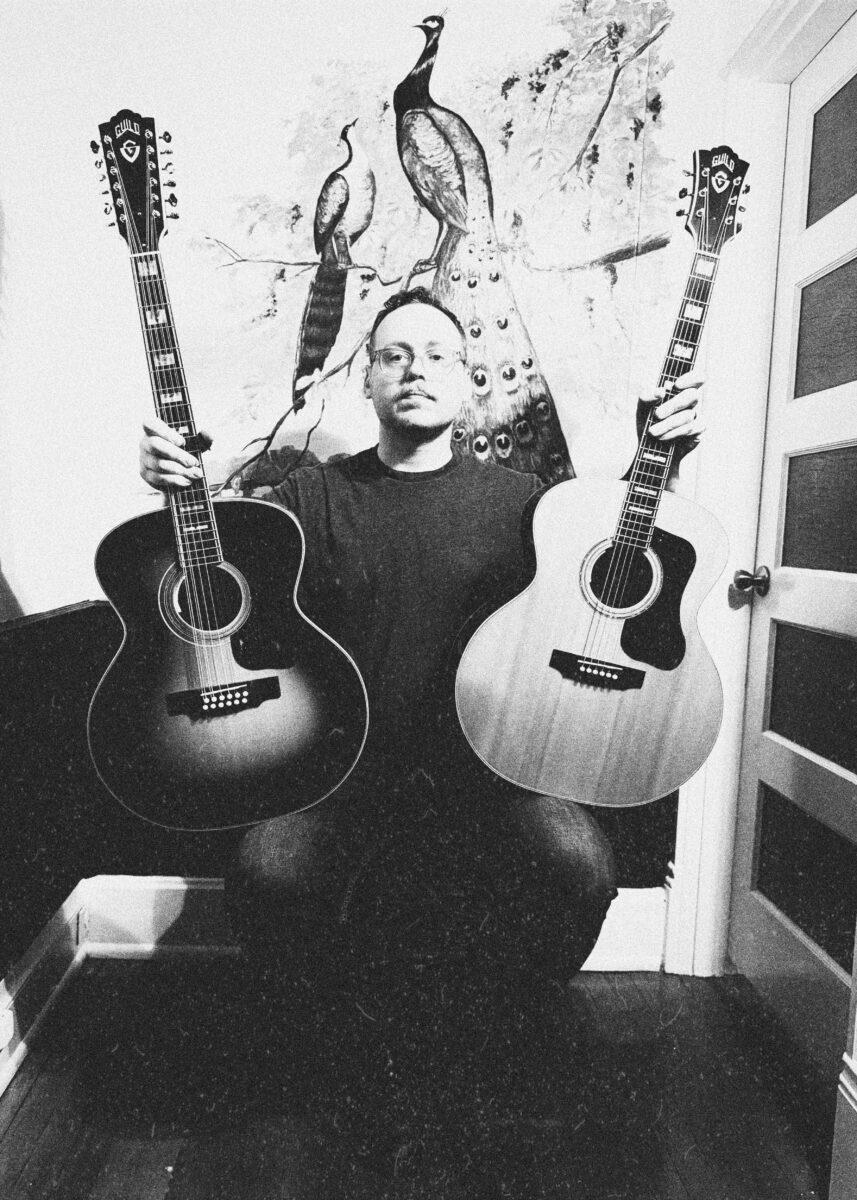
HB: It is very attention-grabbing, and I can see why you’ve started your sets with it. I think people have in their minds what an acoustic guitar sounds like, and then they hear the twelve-string and it’s just much bigger, it really does grab your attention when you hear one.
RM: The songs that I play even on the twelve-string, I could easily play them on the six-string, but there is that specific sound, there is that specific presence that I wanna bring to the set to create that experience and to express myself. There’s a lot of emotion that can come out of that out of the twelve-string. One of the other things that I like playing with is the dynamic of the instrument as well. So, how hard I hit the strings, what happens to the strings when I hit them very hard, there’s a little bit of a detune in the note, you get some fret buzz or some textures, and things that really come out of both instruments. It’s like two different things and you can access different things with them. Obviously with the twelve-string, you’re having the dual notes, right? You’re having the octave notes that are coming out, so you get an interesting sound. With the Guild, I have a really heavy low string on it so I can really hit it hard and get some nice, sort of detuned resonance out of it. The guitar becomes a tool to really create a mood, and it’s even outside of the note. It’s what happens to the note when the string is hit. What’s some of the distortion of the fret buzz that happens and things like that?
HB: And I feel like those things affect the note, but are also beyond the note itself, and what the guitar has to offer by one just playing notes.
RM: And that’s where the interest comes with open tuning. In a lot of ways, this kind of music pushes the intentions of the guitar, or what the perceived concept of a guitar is. The open tunings allow for broader strokes, for more ringing out of notes, fuller sound. But it also provides some interesting dynamics, again, with the ringing out of the string, the detune of the string. It presents itself as a different character.
HB: In your music, which tunings do you use?
RM: I’m usually in open C-tuning, but I’ll mess with that a little bit. I’ll tune the top E-string down a couple steps, so I’ll play around within the open C-tuning to get different vibes. And then, I have a partial capo that I use sometimes by Glenn Jones. I sent him an email and had him make me one. That accesses different tuning modes as well, so that unlocks some things. There’s a couple tunes where I have the partial capo that just covers the bottom three strings. So if you’re in some sort of open tuning, you can change the key just by moving that bottom one, while keeping the top three strings the same. You can tune with those or you can keep them the same and access different modes.
HB: I didn’t know that partial capos were a thing, that’s really cool.
RM: If I’m being honest, the one that he makes is the only one of its kind that I’ve ever seen that gets the bottom three strings. A lot of them are going to just be used to go into DADGAD or something. There’s some partial capos that don’t hit the last string, but maybe the fifth, fourth, and third string, just so you can go into a DADGAD tuning. That’s the only other one that I’ve seen. Glenn’s a super nice dude, he’s also a player that I really respect. If you wanna talk about freedom of expression with a guitar, I reference him in a lot of my thinking, his musicality and also his recordings. You listen to his recordings and you’re hearing so many different things, you’re hearing the string buzzes, you’re hearing some detuned notes being hit, and there is…it’s not even imperfection, but there is just more of a presence of the artist in it, right? You’re hearing the fingerpicks, you’re hearing the movement, the string shrieks as he’s going up and down. Maybe he doesn’t fully hammer down a string and you hear a little bit of a buzz. To me, that’s one of the things like when we were talking about the inner voice, trying to quiet that, that’s some of the stuff that I’ve been doing as well. Just being okay with the guitar as it sounds.
HB: Even some of the most seemingly lo-fi recordings still buff a lot of that out. It’s interesting because it’s just not realistic in a way. I don’t necessarily want to get into an authenticity discussion, but it’s just the fact that that’s not how the guitar sounds. If you play guitar, you know that all of those elements are a package deal. It’s interesting because I do block them out a bit. Sometimes I forget how squeaky it is, and then I listen back to a recording and all you can hear is the squeak going up and down. It’s funny because you do learn to tune it out a little bit, but it comes with the territory, and I like when artists choose to leave all those elements in because that is just how that instrument sounds.
RM: The guitar becomes an active participant in the composition. It’s less about trying to hide it. There’s a lot of stuff in music production where you’re trying to hide all that stuff. Now, don’t get me wrong, there are definitely squeaks and buzzes and stuff where I’m like, “Mm, I’m gonna have to maybe take that one out.” It’s interesting because to the listener, they might not even notice it. There are things that you hear sometimes where I’m like, “Should I take that out?” But then I like the way that it plays into the music, so most of the time I’m trying to leave those things.
HB: That gets back to the idea of how it’s not just about the notes. Sometimes when, in production, things are taken out like that and covered up, it’s because there is such a focus on what exactly the music is, and not so much on how it was created. That’s something I really like about lo-fi music or things like that. It feels like, this is happening in real time. You’re hearing something unfold.
RM: You have the vibe of immediacy of it. I am a big proponent of the room being part of it too, the sounds that are happening, things like that. A lot of my albums, with I think the exception of the last one, Empress, there was a little bit more of production put in. But for the most part, if you go back and listen to them, you hear the room, you hear that it’s happening in a space, it doesn’t sound like it’s done in a sound-treated room or something, and I like that. All of the music and all of the players that I respect, there is an element of that, that to me makes it a little bit more accessible and, not to throw the word out that you were saying, but authentic in my perspective, right?
HB: I kind of feel it too. I have a very complicated relationship with authenticity. I think it’s something that gets weaponized in how music is thought about. But at the same time, I really crave it though. I really do. I love when I can feel every moment of the music and it doesn’t feel like it was taken outside of that moment. Sometimes that itself is manufactured, but still, I agree though. It does make it feel more authentic.
RM: And don’t get me wrong, there’s songs, there’s music and musicians that I respect and appreciate that do have super-high production values. But for me and how I want to express myself, I tend to go more of the lo-fi route.
HB: I noticed a couple tracks on your earlier records were noticeably more lo-fi than others on the record. What was behind that?
RM: Playing with space, playing with themes. My intention is never to have every single track sound like it was done in the same space. You start to create a thematic story through sound with some of the quality of things. Some of it, to your point, was manufactured, but there are ones that have maybe dialed up reverbs, so it sounds like it’s in a bigger space. Ones that sound like they’re just in a room and you’re hearing the wood and the floors and the walls and everything, things bouncing around. I’ve never set out that every song needs to be recorded in the same space. There were times where I was going to different rooms in the house or trying different areas to get different sound quality.
HB: That’s like earlier before we started recording this [interview], this was like the studio versus recording in your own home. You don’t have that kind of flexibility when you’re in a studio, but when you’re doing it in your own space, you’ve got so much room to play around with space in the way it sounds like you really like to do.
RM: Yes, yeah. There were times where I would be like “Oh, let me try this in the stairwell.” Because there’s wood there, there’s higher ceilings for the sound to travel around, just to see what happens. We have a cedar closet in the attic and I’m like, “Oh, it would be interesting to see what happens in there, right?” But that’s more in the house that I’m at now. A lot of the earlier albums, that’s when I lived down in San Francisco. So it was more about the apartment’s space that we were living in, trying different areas there, the kitchen versus one of the other rooms, moving around the space just to see what I could get with that.
HB: I was gonna ask you about San Francisco. Comparing a little bit, what that scene was like playing there versus, how do you feel about the scene here? Do you feel like there’s been a community that you found for the kind of music that you do?
RM: I think both cities have pretty solid music communities. San Francisco was really where I started this endeavor. I was playing metal music before, and then I moved out to San Francisco and I had these songs that I’d been writing. I wasn’t really focusing on them because I was playing metal music with my band. But I was also writing these acoustic songs and I didn’t really know what to do with them. Moving out from San Francisco meant I left my band. It was kind of a restart on a lot of things. So I was like, “Let’s try these songs.” It was really easy to just get out there and start to perform, start to polish those, and it was pretty quick to find a community. There’s a really good open mic at the Hotel Utah there in San Francisco that was where I started to really play these songs. And then I was connecting with people there and one thing led to another to connecting with other musicians out there — it was good.
I also like feel like Cincinnati has a very solid music scene in a lot of ways. There’s a lot of community here and it’s easy to play shows to connect with others. I don’t know, there’s something about it. I don’t know if it’s the location or what, but people are coming through. In the past couple years, we’ve been getting some really good solo guitar players coming through here, like Liam Grant is one of them. Ethan [WL] just was here, Joseph Allred came through here, all these guys are coming through these parts. I would love to have them continue to come through these parts. There’s something about Cincinnati where it’s like a throughway, so you get a lot of people stopping through and I feel like that makes for a good community. There’s a pretty decent DIY community here.
HB: I’ve always said ever since I moved here, I always felt like [Cincinnati] was a crossroads kind of point. I think that it’s geographic, and it’s cultural, and it’s locale. It’s equidistant from so many major cities, whether you go to Chicago or St. Louis. And the history of the city too, being such a crossroads of so many different musical styles over the course of time. I think that’s a huge part of why it’s got the reputation and the vibe that it has.
RM: It’s sort of a hidden gem. I don’t feel that in another places. I don’t know, there’s something about Cincinnati that’s cool. Also, there’s something about Northside, living in Northside and being at the [Northside] Tavern, The Comet, soon to be The Loon again. I’m into finding unique venues or venues that suit an experience where everybody’s kind of close in, right? It’s very intentional.
HB: I feel like playing kind of bigger spaces could be nice just for exposure, but you are less the whole point. When someone is in a hurry, they’re just there to chat with their friends and hang out, and it’s nice that there’s music there. Versus playing in a place like The Loon where everyone’s very intentional, being there to hear that music.
RM: And there’s something to be said for if like Girl Gordon [HB’s band] were to play in a space like that it makes sense. There’s enough sonic volume that you can command attention. Now, somebody like me who’s doing more of the solo guitar stuff and really requires listening for the intricacies of what I’m doing, that’s where that kind of falls off. I’m just thankful that there are venues like that.
HB: It could be easy to get lost in those bigger spaces.
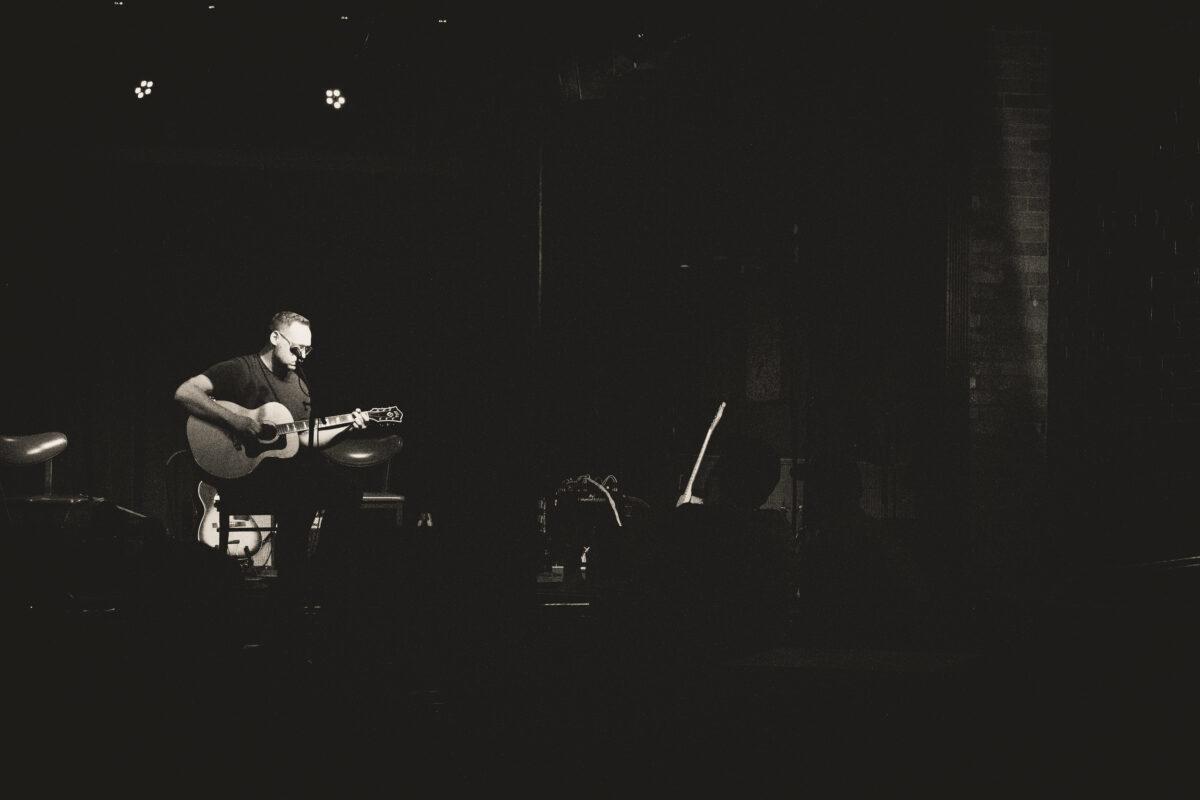
RM: So interestingly enough, it is about everything being an active participant in the composition. The room is very much that as well. The audience is that. One of the biggest and best things that I love the experience of when I’ve been playing, there’s a point where you can just feel like…I don’t know if it’s like a gravitational pull, like the silence and the people, there’s sort of a back and forth where they’re totally engaged and you can feel it, and you can start to play a little bit with the silence. Maybe you hit the notes a little softer and bring people in, and you can feel that. I’ve felt it before, and it’s crazy. It’s a crazy feeling when you’re up there and you’re like, “Everybody’s locked in on me right now.” I can feel that, and I can start to play with bringing you in closer. And I won’t find that in larger spaces. I need to have smaller spaces like that.
HB: You brought up the Northside Tavern. Maybe a couple weeks ago now, I was playing a show at Northside Tavern. Recently, the local old time jams moved there to the front room, and they were going to be playing for an hour before we would go on. We needed to go sit and listen to them, and we wish we had our acoustic guitars, because you can’t play an SG at an old time jam. But it was just so nice. It had been a while since we’d been to one, even just listening to them. Old time jams fascinate me beyond belief and I loved the way that space functioned, and it’s the front room so everyone’s kind of walking in, walking out. I was watching people at the bar, and some were talking and then would perk up and listen for a moment, and it was very fluid. It just felt so natural, and I think that is also the essence of a jam, people do come and go. Someone showed up for the jam and they’d been going at it, like 45 minutes, and someone’s like, “Here! Sit down,” and they start playing. A space like that, like that area for Northside Tavern was perfect for what they were doing. It filled the space, and it could command your attention, but it also was something that you could look away from for a moment, do something else. And you could technically join in if you wanted to.
RM: And do they play in a circle in the front?
HB: Yeah.
RM: Again, that speaks to the experience that you’re trying to set. To me, those open jams are about filling the room with a sound, with a soundtrack. Me sitting up there in my chair facing the audience, that’s gonna be more like, watch and let’s lock in, versus, [the jam], it’s like they’re there for each other. Everybody else in the room is more of a bystander, or an observer. So that is cool.
[we dive into details about various Cincinnati venues, and we land on Conveyor Belt Books]
HB: The show you did a few weeks ago was at Conveyor Belt. I’m very fascinated with Conveyor Belt right now. They’re starting to fill a really interesting space in the area. They’re selling books, they’re selling like, cult books. But I feel like they’re engaged in the broader cultural community. They’re starting to do more film stuff like at the Esquire [Theatre], they’re having these really intimate shows. They also started that thing, it’s not a newsletter, but that thing where it’s a sheet with only events, with everything that’s going on and trying to detach that from social media. I just wonder about your thoughts on them. Because I haven’t played there, so also maybe from that perspective.
RM: I love that space. I love what they’re doing, like what you’re saying, they’re going far beyond just being a bookstore and being a space where things can happen on a creative level, whether it’s music, whether it’s art, poetry, things like that. I think we need more spaces like that. There’s a time and a place to play in a bar, sure. I just love the idea of like music being experienced in a place where there’s not alcohol being thrown around, and there’s not the other shit that comes along with being in a bar. Like there’s more of an intentional understanding. I feel like the audiences that show up to that place, they’re in it, they’re coming to listen to music. That’s why they’re there. That’s very exciting to me. [Conveyor Belt’s] always been super nice to deal with and communicate with, they very much seem like they’re trying to create that central community just for creativity, whatever form it is. I’ll continue to try to play there. I love it there. I think the sound is great there. There’s something really magical about being able to just sit in a room, pull out your guitar and play it, and not have to plug it in, not have to do soundchecks, not have to have PA, You have your small space, you have your audience, you have just your guitar. That’s it.
HB: That almost just feels like you’re playing amongst friends, you know? It feels less performative, in a way.
RM: There’s something about occupying a space that isn’t a conventional space for music. Like in bars, you have a stage, right? Or there’s an intentional place where music will happen. With something like this, you kind of occupy the space, you figure out where is the best angle, the best place to set up, and people are sitting around bookshelves and things like that. It creates a little bit more of a unique experience. I love that place. Just from playing that show, I was connected to a beat poet [Kenneth Patchen] that’s actually from my hometown. I had no idea that this dude existed. I played the song that you were talking about, that I opened with that you heard, where I let ring out. That one’s called “Mahoning River Stomp.” The Mahoning River is from northeast Ohio. It’s a river that runs over there and I grew up by it. This guy there was like, “Oh yeah, Mahoning River, like do you know such and such? He’s a really awesome beat poet, and he was the first beat poet to read to jazz music.” I started to look into him and they had his books there. To me, that’s the importance of spaces like that, connecting you to different mediums.
HB: It makes everything a little more interdisciplinary. All of these things that we do, whether it be writing, poetry, film, music, art, all of it is interconnected. I think sometimes our spaces get sectioned off a little bit too much, and what I really love about Conveyor Belt is that I feel like they’re trying to erode that boundary a little bit. I think it’s hard for us to see sometimes how connected we are to different styles of art and to have a space where that boundary isn’t necessarily there is really cool.
[we talk more at length about Cincinnati venues and then funnily enough, Mohan turns the tables and interviews me for awhile, we talk about the shop, my writing, etc.]
HB: I had interviewed Daniel Bachman for The Absolute Sound.
RM: He’s such a cool dude. He’s just so approachable.
HB: It was one of the most fun conversations I think I’ve had with anyone I’m interviewing. It was just an immediate kind of, very nerdy conversation. Honestly very similar to this one, this has been a blast! Within seconds, [Bachman] started getting into the minutiae of how a certain thing worked in his rig.
RM: He’s doing some cool stuff right now. In my mind, he’s sort of deconstructing the idea of what solo guitar music is. I just love this new stuff that he’s starting to experiment with, like editing, doing more soundscape-type stuff. It’s crazy, some of the stuff that he does, like where he records this song and chops it all up, reconfigures it, hearing that stuff, even with the music that I’m doing, I love that. It goes again to the internal voice. We try to perfect things so much. He’s like, “I just chop it all up. I put it together and slow things down.” That is so interesting. You’re destroying something you just recorded to create something new. And you can’t be too precious about it.
The other thing that I was gonna say was, we were talking about how cool he is, and I feel like a lot of people in this American primitive genre, it’s a very positive, embracing network. Even some of the people that I really respect, like Joseph Allred, like I’ve played shows with a lot of them, and I’ve been in communication with a lot of them, and they’re super accessible. It’s not like they’re behind some magical wall. They’re just normal people, just hanging out, and you can reach out and comment on things and have a dialogue. Liam [Grant] and Ethan [WL], they’ve come through a couple of times, stayed at my house, stuff like that. Like Glenn [Jones], having email correspondence with him and having the partial capo, it was just interesting. That’s something he perfected, but he has no problem with making them for other people to do similar things. There’s a creative encouragement.
HB: I think that’s a huge part of why I also love interviewing people in this particular community, because I feel like they are so easy to talk to and converse with. And they’re very open, I feel like they’re not holding anything back. They’re not trying to be anything but themselves. I feel like it’s so easy to have an open conversation with them. Interviewing Daniel, it just felt like I was talking with a friend, and I had never met him before. We had only spoken via email, we had never shared a single word, and it was like immediately he let me know what’s going on with his music. That is really cool, because I think that could be hard to find with other genres in music. To some degree, DIY musicians are like that, not that everyone who’s instrumental acoustic is DIY. But in general, DIY musicians just don’t have that barrier between themselves and who is listening to their music.
RM: Yeah, it’s about creating accessibility, and not hiding behind some sort of mask or false idea of what this person is. We all just try to help each other. This was a long time ago, but with a lot of those guitarists, I just messaged them like, “Do you guys use metronomes when you record your songs?” Everybody got back with what they do. And it can easily be like, “We’re not gonna tell you, we don’t wanna tell you how we go about our recording process.” But it’s not like that. It’s just very open dialogue on how we’re approaching it, which I love. I think that’s one of the things outside of being able to express myself in a different way, another piece of why I’m so interested in this kind of space, whether you wanna call it American primitive music or whatever. It’s something of interest to me right now in terms of my own identity and my own expression.
Note: This interview has been edited for length and clarity.
October 2, 2025 | Blog